
At the SGT Lecture in May we were pleased to welcome back Dr Sarah Rutherford, who gave us a fascinating talk about the eighteenth-century artist and architect, Thomas Sandby. We last met Sarah when she spoke to SGT in 2016 at Ashburnham Place about the world of Capability Brown as part of his tercentenary celebrations. As a Kew-trained gardener and formerly Head of the Parks and Gardens Register for English Heritage, Sarah has written several books on garden history and her most recent project is researching the history of Georgian grottoes for a forthcoming publication.
Sarah’s talk began at Windsor Great Park, where in 1743 Thomas Sandby was appointed private secretary to the Duke of Cumberland and became deputy Ranger of the Great Park. With the patronage of George III, he planned considerable alterations and additions in the Great Park and his designs included several houses in the area as well as a stone bridge over the river Thames at Staines.
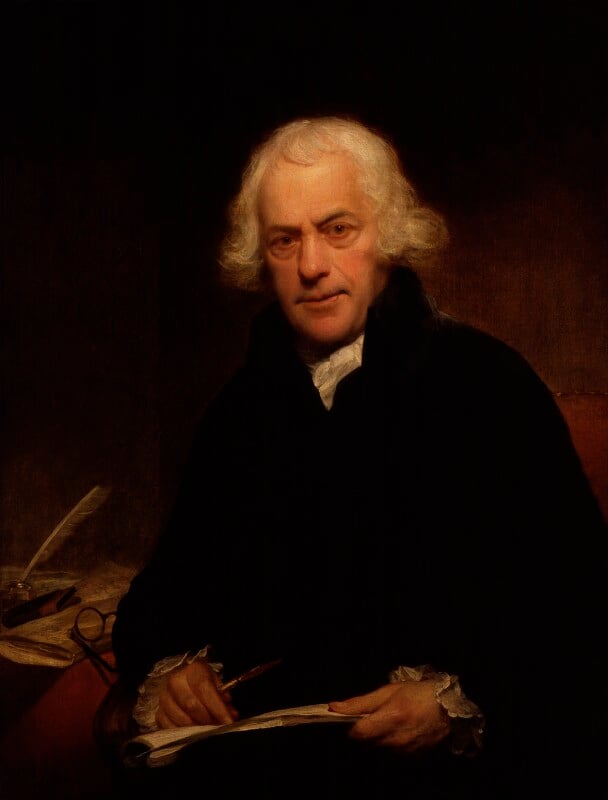
Oil on canvas, 1792, NPG 1380. © National Portrait Gallery
The Duke of Cumberland had created Virginia Water Lake in Windsor Great Park, commissioning the architect Henry Flitcroft, but after floods destroyed the original rock works in 1768 Sandby was asked to design a new cascade and grotto. George III, who was then suffering from severe mental illness, had made the Great Park his retreat and appointed Sandby to draw up plans for the enlargement of the lake. Sandby’s design increased the size of the lake to 132 acres, becoming the largest artificial expanse of water in the country, surpassing even the lakes of his contemporaries such as Capability Brown. Sandby’s drawings of the lake, the cascade and the grotto were then made into engravings, popular in Europe at the time, and it is these depictions, together with his illustrations, that have survived when much of Sandby’s work has disappeared. Sarah’s research has examined these drawings, scattered in archives and museums across the world after Sandby’s death in 1798, which offer a fresh insight into an artist and architect and giving him the recognition he deserves.
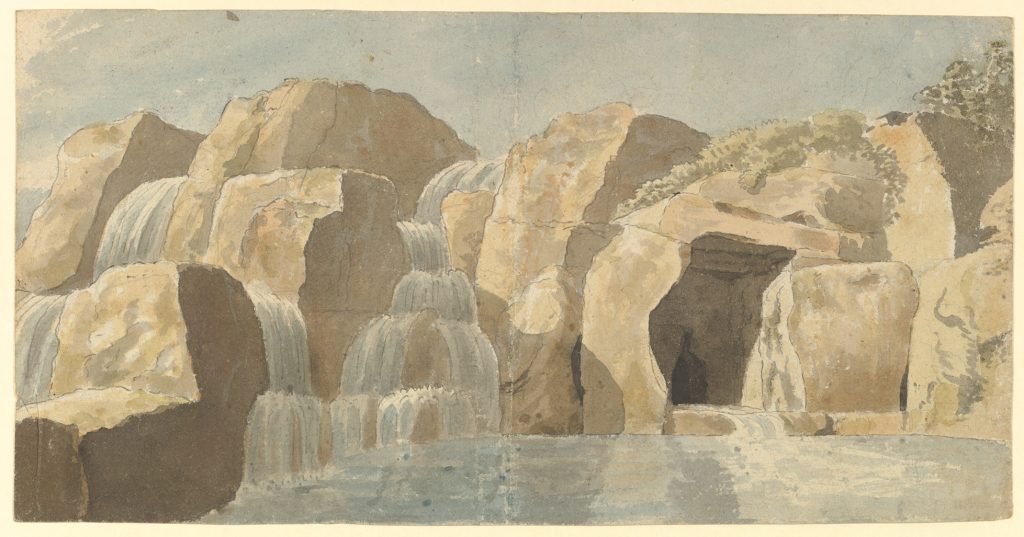
The Metropoliotan Museum of Art
When the pondhead of the cascade collapsed not long after its construction Sandby acquired the nickname ’Thomas Sandbank’ – the structure having been built on sand. A stronger cascade and second grotto was built in 1783, fortuitously as Sarah explained, in time for the King’s recovery in 1789.
Illustrating her talk with Sandby’s finely painted watercolours, Sarah showed us how entering these grottoes must have seemed like stepping inside a cave of mystery and surprise. The walls of the grotto at Virginia Water were decorated with quartz crystals and spar stones and from the upper level visitors could look down on the cascade. Nearby, at Ascot Place on the edge of the park, an obscure drawing by Sandby shows a grotto, built by Robert Turnbull around 1750, which had four different rooms or chambers, with steps up to a viewing platform, and an octagonal lantern in the roof. The walls were covered in shining white quartz crystals, and the ceiling decorated in stalactites of more crystals.
At the end of Sarah’s lecture SGT members suggested their own definitions of a grotto. Originally created for a sacred purpose for gods or nymphs, perhaps these eighteenth-century popular additions in the landscape were intended as a folly by water, to stir the imagination with their elaborate decoration of thousands of shells and shiny stones. A sense of the ‘gothic frisson’ was suggested, and a ‘sparkle never to be forgotten’.
Long before the days of Powerpoint presentations, Sandby apparently illustrated his lectures at the Royal Academy with drawings and watercolours of his projects, amazing his audience when he unrolled a drawing half the length of the lecture room.
Now it’s so much easier – but we were just as delighted as Sandby’s audience by Sarah sharing her research findings and bringing to life the enigmatic Thomas Sandby and his story at Virginia Water Lake.
If Sarah’s talk has left you wanting to see more of grottoes there are two in Sussex which can be visited: Goodwood House Shell Grotto, and the Shell Grotto in Margate is a delight. In Surrey there’s the magical Crystal Grotto at Painshill. Sarah’s new book is planned for publication in 2027.
Article by Sally Ingram