
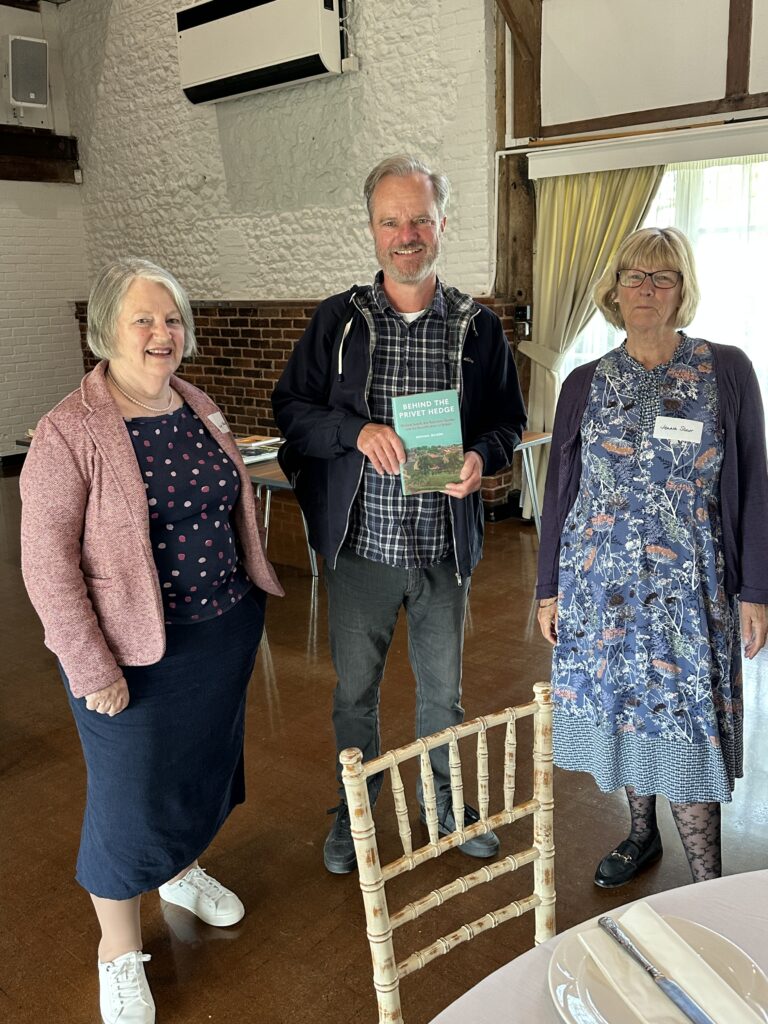
The guest speaker at SGT’s 30th Anniversary Event was Michael Gilson, editor, journalist and author of Behind the Privet Hedge: Richard Sudell, the suburban garden and the beautification of Britain.
For Michael Gilson the twentieth century egalitarian movement in gardens can be epitomised by two very different roses: the bold and vibrant Betty Uprichard and the refined and delicate Madame Louis Lévêque. While Madame might be at home in the country house garden, complete with an army of gardeners to care for extensive Jekyll-inspired flower borders, Betty’s brash colour enlivened the drab inter-war years, bringing a much-needed vibrancy for the suburbanites with their small garden plots on the new estates.
Suburbia has encountered its share of ridicule, as Michael said, suggesting curtain-twitching, and secrets buried behind the privet hedge. ‘Metroland’, the suburban areas of north-west London, was gently mocked by John Betjeman, while George Orwell in his novel Coming Up for Air described the streets of suburbia as no more than ‘lines of semidetached torture chambers‘. For the poet D H Lawrence, the bleak uniformity of houses in rows, and people moving like ants beneath bare street lights, suburbia was ‘a blight on the land’.
In his entertaining talk for SGT’s anniversary event, Michael Gilson presented an alternative story of suburbia, turning the perceived snobbery upside down and defending these ‘homes fit for heroes’, built for the thousands moving from overcrowded and polluted cities to estates like Downham and Roehampton. He explored a fascinating social history of the gardens offering new homeowners just 400 square yards of outside space, often covered in rubble and building materials, but which they could make their own.
Into this story comes Richard Sudell, a prolific editor and garden writer, of 47 books as well as articles for popular magazines, and even the text for cigarette cards, but largely forgotten in the world of landscape architecture. Drawing on the research for his latest book, Michael shared with us how important Sudell was to the inter-war suburban garden movement. After a time in prison as a conscientious objector Sudell moved into the Roehampton Estate – where ironically the houses had been built as part of the homes for heroes campaign – and soon formed the Roehampton Garden Estate Society. He provided practical garden advice and instructions for the community, organised shows and galas with competitions to promote everything horticultural. As a founder member of the Institute for Landscape Architects, along with Geoffrey Jellicoe and Brenda Colvin, he was an advocate for greater recognition for the profession. As well as gardens Sudell designed cemeteries, parks and playgrounds and believed that everyone was entitled to enjoy a green outside space – a sentiment which still matters today.
We were delighted Michael could be our guest speaker for our anniversary event, and for revealing so much of his hero’s achievements behind the privet hedge.
Article by Sally Ingram