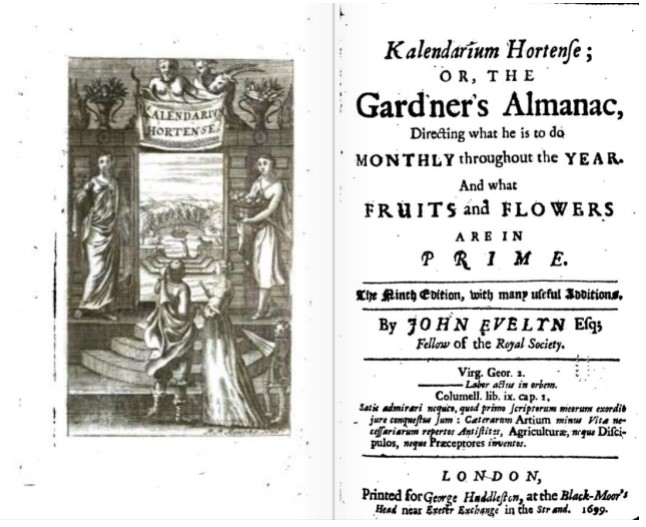
A seasonal selection from Kalendarium Hortense; or, the Gard’ner’s Almanac, Directing what he is to do monthly throughout the year. By John Evelyn, published 1706, tenth edition.

As well as being a famous diarist, John Evelyn, who grew up and went to school in Lewes, became the unofficial seventeenth century’s national garden adviser in chief. His ‘Hortulan Kalendar’, from which extracts are set out below, was originally part of a massive gardening encyclopaedia, Elysium Britannicum or The Royal Gardens which, alas, was never finished or published, but parts such as the Kalendarium Hortense were published separately. As well as the Kalendarium, Acetaria, or a discourse on Sallets and Sylva, or a discourse on forest-trees, the first publication of the newly-formed Royal Society (1664), are probably Evelyn’s best-known works. The Elysium has been transcribed by John Ingram from the manuscript held in the British Library (University of Pennsylvania Press, 2001).
Being a Gardener in the Seventeenth Century
The garden calendar describes Evelyn’s experience of hands-on gardening month by month in the orchard, ‘Olitory’ (vegetable) and flower garden. His advice and cultivation methods show how much scientific advances have changed the way we garden, but also how many of his ideas were far in advance of his contemporaries and anticipated many modern trends.
Evelyn was very conscious of the pollution caused by smoke in and around London which he thought contributed to ill-health resulting from the lack of fresh air. In spite of not knowing about carbon emissions he had an idea that plants and trees would counteract the effects of the smoke and proposed plantations of trees and sweet-smelling flowers in and around the city, published in the pamphlet Fumifugium: the inconvenience of the aer and smoak of London dissipated (1661).
Gentlemen were expected to be skilled enough to do their own ‘graffing’ (grafting) of fruit trees, and, as well as saving seed, to generate new plants from slips and cuttings. Cultivation of the orchard for beauty and usefulness chimed with the seventeenth-century religious outlook which found God’s signature in the garden (see Ralph Austen, The Spiritual Use of an Orchard, 1653).
Another discovery which still lay in the future was the breeding of varieties. In the early eighteenth century Thomas Fairchild uncovered the shocking secret of creating new varieties (plants having sex!) by crossing a Sweet William with a Carnation (see Thomas Fairchild, The City Gardener, 1722; Michael Leapman, The Ingenious Mr. Fairchild: the forgotten father of the flower garden, Headline, 2000). Evelyn describes his methods for attempting to produce double flowers and new forms, but at that time these were random and unproven.
Not all aspects of garden activity show beneficial advancement since the seventeenth century. One of the most striking aspects of Evelyn’s calendar is the list of fruits available each month, all year round. Even in his January list, ‘Fruits in Prime, or yet lasting’, there are thirteen varieties of apple which have good keeping properties, and three of pears (not counting those implied by ‘&c’), making us realise how many of these old varieties have been side-lined to extinction by modern global commerce. Fortunately, many Sussex orchards are now reviving and cultivating the older varieties (see Brian Short, Apples & Orchards in Sussex, Action in Rural Sussex & Brighton Permaculture Trust, 2012).
Jobs for the gardener in the month of March
In the Orchard and Olitory-Garden
Now is the best time for pruning young Murals, and, indeed, other Wall-Trees. Graff all this Month, beginning with Pears, and ending with Apples, unless the Spring prove extraordinary forwards.
It were profitable now also to top your Rose-Trees (which always bear on the fresh Sprouts of the same Spring) a little with your Knife near a Leaf-bud, and to prune off the dead and withered Branches, keeping them lower than the Custom is, and to a single Stem.
Note that Rosemary thrives better by cutting off the Sprigs, than by ragged Slips, which leaves an incurable Scar on the old Plant.
Where the soil is Clay, or over moist, mingle it plentifully with Brick-dust.
Whatever you Sow or Plant, water not over hastily, nor with too great a Stream, for it hardens the Ground, without penetrating; rather endeavour to imitate the natural Shower; but spare not Watering if necessary.
In the Parterre, and Flower-Garden
Stake and bind up your weakest Plants and Flowers against the Winds, before they come too fiercely, and in a moment prostrate a whole Year’s Labour.
Now do the farewell Frosts and Easterly Winds prejudice your choicest Tulips, and spot them; therefore cover such with Mats or Canvas to prevent Freckles and sometimes Destruction. About the end uncover your choicest Plants, but with caution; for the tail of the Frost yet continuing, and sharp Winds, with the sudden darting Heat of the Sun, scorch and destroy them in a moment; and in such Weather neither sow nor transplant.
Let this also caution you upon all such Extremities of Weather, during the whole Winter; but be mindful to uncover them in all benign and tolerable Seasons and Intermissions; it being these acute Winds, and seldom or never the hardest Frosts or Snows, which do the mischief.
In the mean time let Gentlemen and Ladies, who are curious, trust little by Mangonisme [adding manganese], Insuccations [soaking], or Medecine to alter the Species, or indeed the Forms and Shapes of Flowers considerably, that is, to render that double, which Nature produces but single, &c. but by frequent Transplanting, Removing, &c. Inriching the Mould to Multiply and double; and by sterving and hardening the Earth, and consequently taking from the Roots the freer Nourishment, for variation and change. Make much of this Document.
Now is also your Season to raise Stocks to bud Oranges and Lemmons on, by sowing the Seeds early this Month … let the Seeds be of the Sevil Orange, half a dozen in a Pot is enough, plunging it in the Hot-bed … Thus they will have shot near a Foot before Winter.
Article by Judy Tarling
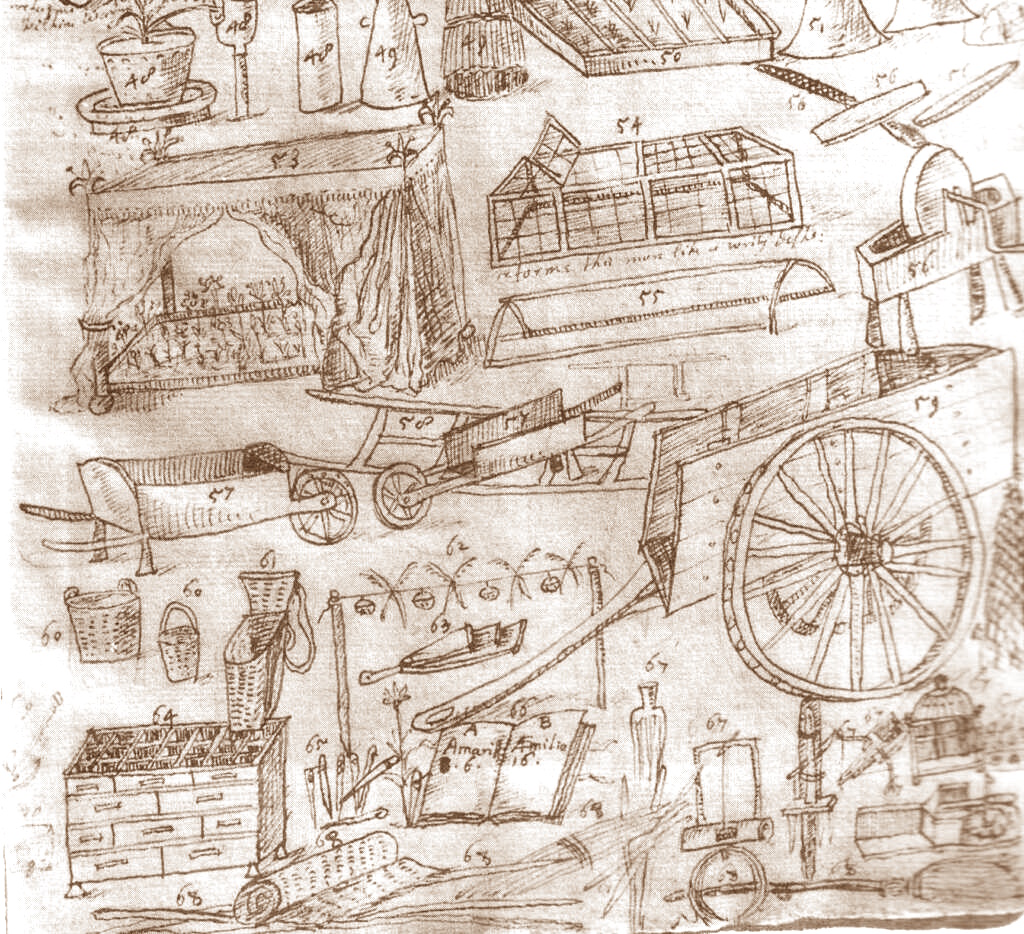
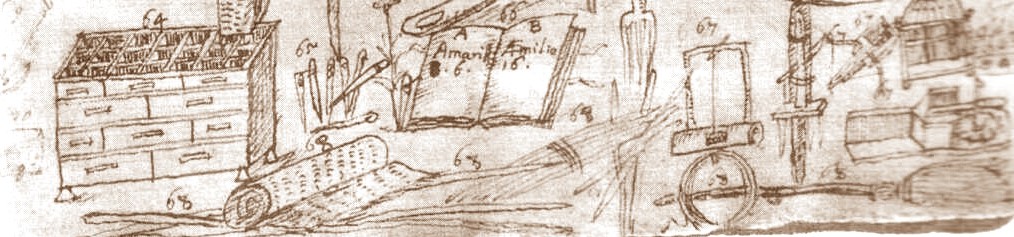
Illustrations: ‘Instruments belonging to a gardiner, and their various uses’. Illustration of garden equipment, including knives, axe, scythe, watering can, ladder, glass cloches and wheelbarrows. John Evelyn, Elysium Britannicum, from The Gardens Trust blog