
Beacons and a Bale House
Hastings Country Park lies in the High Weald area of outstanding natural beauty to the east of Hastings and bordered to the south by cliffs and the sea. It is owned by Hastings Council who began buying land in 1888 and today consists of 853 acres including farmland. The Country Park is accessible from Hasting’s seafront by the East Hill lift which was opened in 1901 and is the steepest in England, or by steps up to the top. From inland the Country Park can be accessed by the road to Fairlight, where there are car parks and views of the fire hills, so called because of the gorse growing there. At the northern end of the park is North’s Seat, erected in 1870, which is 176 metres above sea level and named after Lord Frederick North, who was MP for Hastings and father of Marianne North the botanical artist.
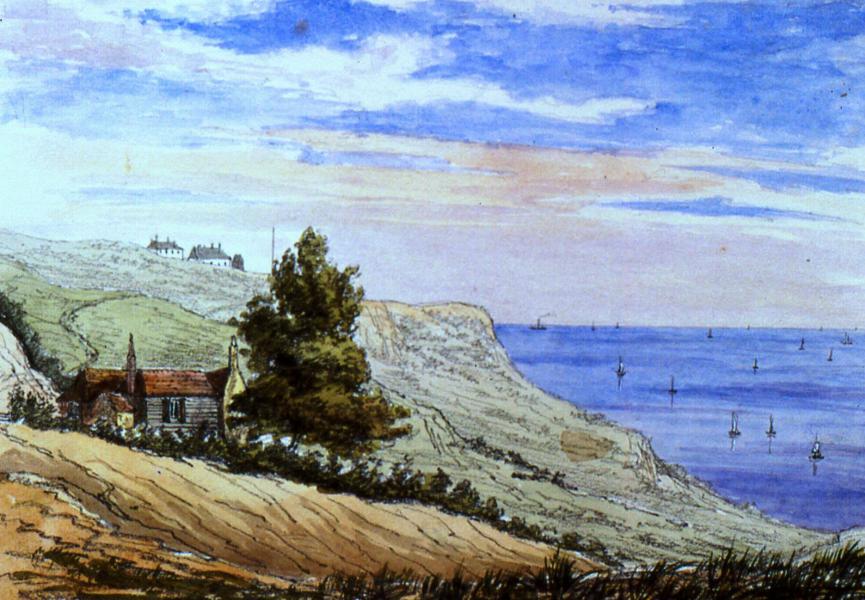
Illustration by permission of Steve Peak.
The beacon on the top of the cliffs at Fairlight was first erected in 1587 due to the threat of the Spanish Armada which arrived in 1588 and when beacons were lit all along the coast to warn of the threat of invasion.
During World War II a radar station and anti-aircraft batteries were installed near to the coastguard cottages and were able to pick up enemy aircraft and doodle bugs and on one day destroyed 97 doodle bugs. The radar station is still operational and the coastguard cottages were rebuilt in 1904.
Many cliff falls have reduced the Country Park along its southern edge adjacent to the sea. One landmark in particular has been lost, the Lovers’ Seat, favoured in Victorian times for young lovers to meet each other and popular with photographers to take pictures of holidaymakers. It was replaced in 1948 after World War II having been destroyed by the military. Footpaths along the cliff edge have to be moved, managed and repaired from time to time to enable access.
The Country Park is used to graze animals to keep the gorse and grass in check. The bracken is broken by horses pulling heavy rollers. There are Exmoor ponies, Belted Galloway cattle and sheep. Sheep were made famous in 1852 when William Holman Hunt painted Our English Coasts featuring sheep on the cliffs at Fairlight.
Sport has been popular in the past, including cricket, football and golf, and a rifle range opened in 1901 in Warren Glen, but nowadays runners find it a good place to keep fit. Many other people bring their dogs for exercise and it is popular with children and walkers.
The Country Park is a haven for wildlife and the Friends of Hastings Country Park arrange many activities to show the wide variety of plants, insects and birds which make their homes there or pass through. There are wild flower walks, fungi walks and bird watching, in particular the dawn chorus and migration. Wild flowers are plentiful and some of the varieties are bee orchid, yellow archangel and hoary ragwort. Butterflies and moths are in abundance and all are protected. Birds you may see include the yellowhammer, stonechat and jackdaw. A seabird, the fulmar, can be seen nesting in the cliffs from the beach at Rock-a-Nore to the East of Hastings.
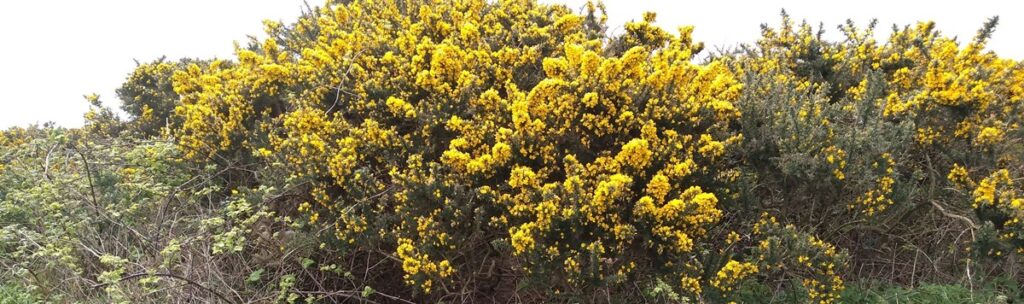
The gorse bushes make a wonderful sight in the Country Park, and wildflowers carpet the ground. Wildflower meadows have been planted alongside the paths and drives which lead from the entrance off the Fairlight Road down to the new visitor centre called The Bale House.
The Bale House is an innovative building used as a visitor centre and cafe which opened in July 2021. It is constructed from straw bales and was built by Huff and Puff Construction with a grant from the EU. It is as eco-friendly as possible and is so well insulated with sheep’s wool that it needs no heating. The building is constructed from natural and recycled materials and wood, lime, straw and sheep’s wool. The only energy used is for lighting and hot water.
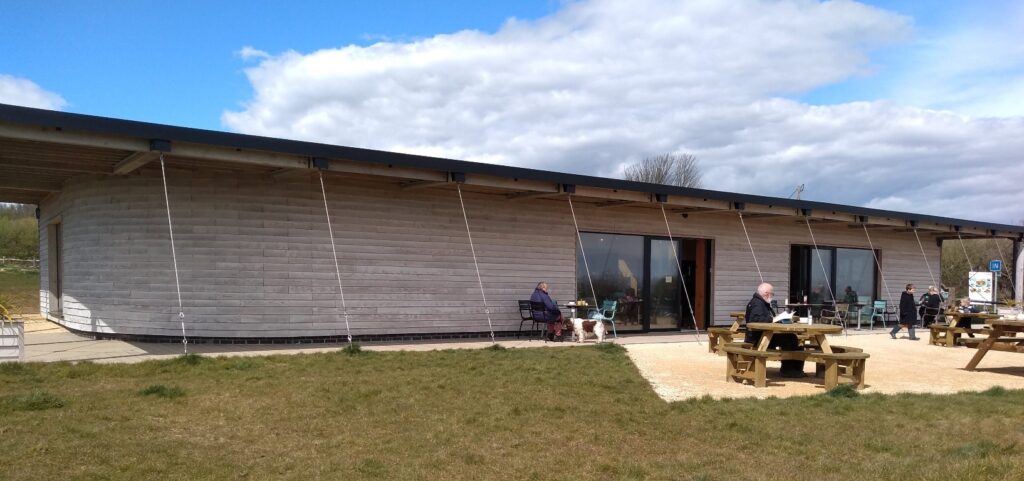
The Bale House has proved a great success and a welcome addition to the Country Park. There are a large number of books collected by the Friends with some specifically for children and child size furniture will soon be added to the bookcase holding the books. Many leaflets have been produced featuring the wildlife that visitors may see, and the latest is one for children focussing on wild flowers they can see in spring and summer and berries and fruits to look for in autumn and winter. The cafe is very popular and busy, with a few tables inside and others on the veranda outside.
Further Information:
- Hastings Country Park – A History by Steve Peak £10.00. This is only available in person from The Bale House in the Country Park.
- Steve Peak’s website will give you much more information about the history of the Hastings Country Park: https://www.hastingscountryparkhistory.com/
- Friends of Hastings Country Park: https://www.friendsofhastingscountrypark.org/
Article by Lynn Gausden
All photos ©Lynn Gausden.