
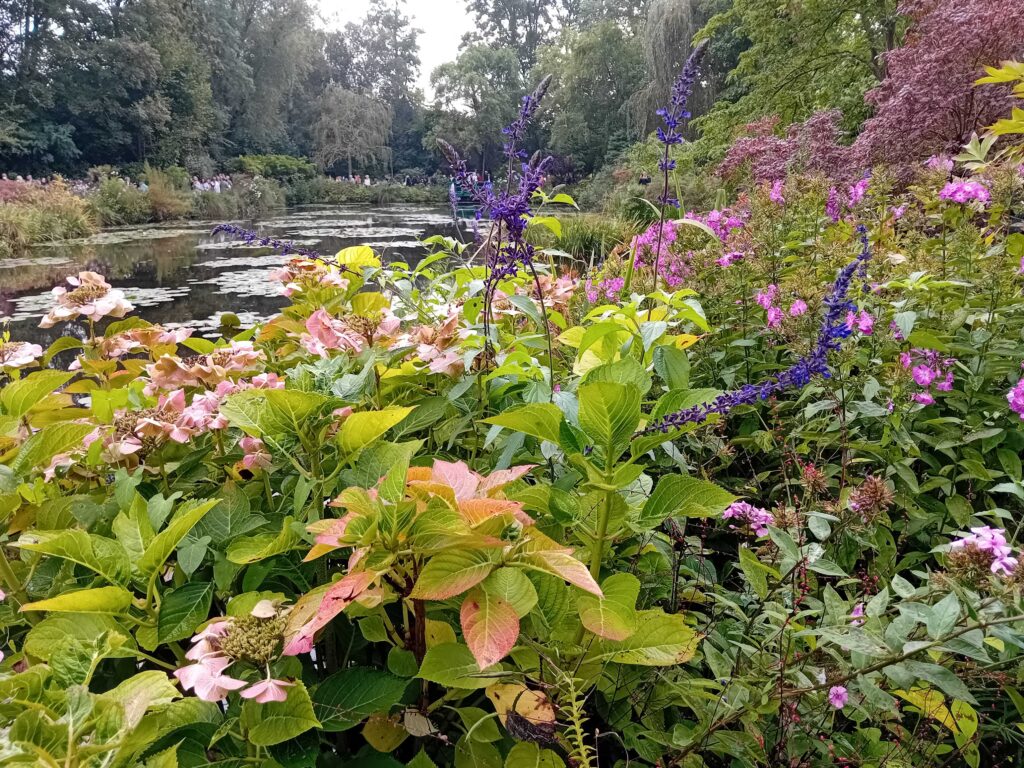
The eastern region of Normandy is largely spacious and peaceful, with small villages of traditional buildings amongst miles of field, forest and river valley. Among its attractions are two wonderful gardens, Giverny and Le Jardin Plume. Each reflects the vision and dedication of its creators, yet they offer contrasting visitor experiences.
Monet’s garden at Giverny is justly world-famous and surely, for anyone interested in gardens and garden history, unmissable. But be warned, it is a major tourist attraction, far from the kind of site that is visited only by garden enthusiasts.
Monet moved to Giverny in 1883, his house and the gardens he created being part of a village complex located by the beautiful Seine valley close to the town of Vernon. The history of the garden is well-documented – see, for example, this short article on the Royal Academy website.
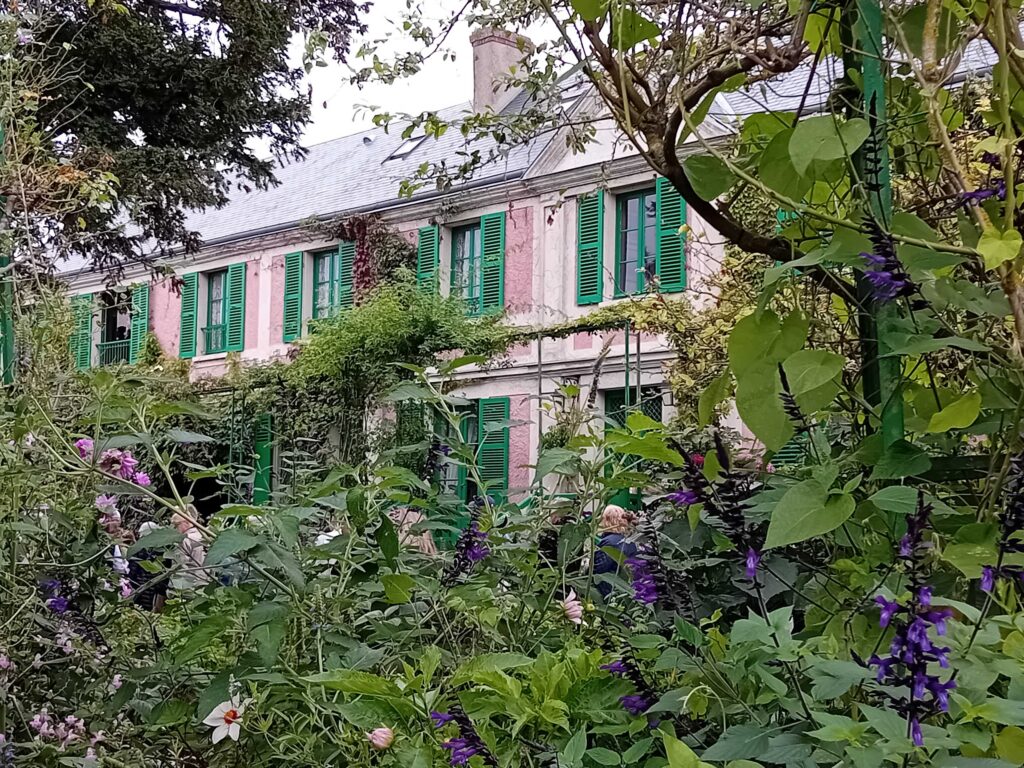
My wife and I had heard that the least crowded time to visit was early morning so we pre-booked tickets for 9:30. That was a mistake; our arrival coincided with that of coaches carrying day trippers from Paris and parties from the massive river boats that cruise the Seine. Bear in mind that this was mid-September, not high season.
Pre-booking tickets[1] usually means speedy access, but here the entrance for those with e-tickets (or a `pass’ in Giverny language) was down a narrow alley lined with stone walls, blocked by tour guides expounding to their entourages. In our view the garden was over-full, certainly beyond comfortable capacity. The paths are narrow; progress around much of the garden was at a slow shuffle and especially difficult for visitors with mobility constraints. There were long queues for the one set of toilets within the walled site (nb the museum lobby has free-to-use toilets with no queues) and the wait to enter the house was at least twenty minutes.
The water lily ponds continue to inspire the urge to produce imagery; but painting has been replaced by the twenty-first century compulsion to take selfies and photos of friends and family, for which Monet’s creation serves as a mere backdrop. Many visitors seemed determined to experience the garden only via a mobile phone.
But hold on, you might say, how hypocritical that I, a tourist who also took many photos with my mobile, should complain about tourists with their mobile phones. The issue is that, for me, a garden is as much about its atmosphere, the `felt experience’, as it is about other senses. It felt impossible to experience the tranquillity and seclusion of Monet’s creation because it was so crowded and busy. Possibly the only way to view it with no people present is through the (excellent) virtual tour on the Giverny website.
I offer these comments so that anyone planning a visit is forewarned; do think ahead about what time to visit, which may of course vary from day to day and week to week. Some people advise arriving towards the end of the day, when the organised trips have probably left.
So, what of the pluses? Tickets were remarkably cheap for a world-famous garden (€11.50 on the official website at the time of writing) – I would gladly have paid twice as much if it had meant halving the number of visitors! Parking is plentiful and free. Apart from Monet’s house and garden and the separate Museum of Impressionism, the Giverny site with its charming residential houses is free to access. Above all, you can step inside Monet’s well-tended world and witness the results of his devotion over many years.
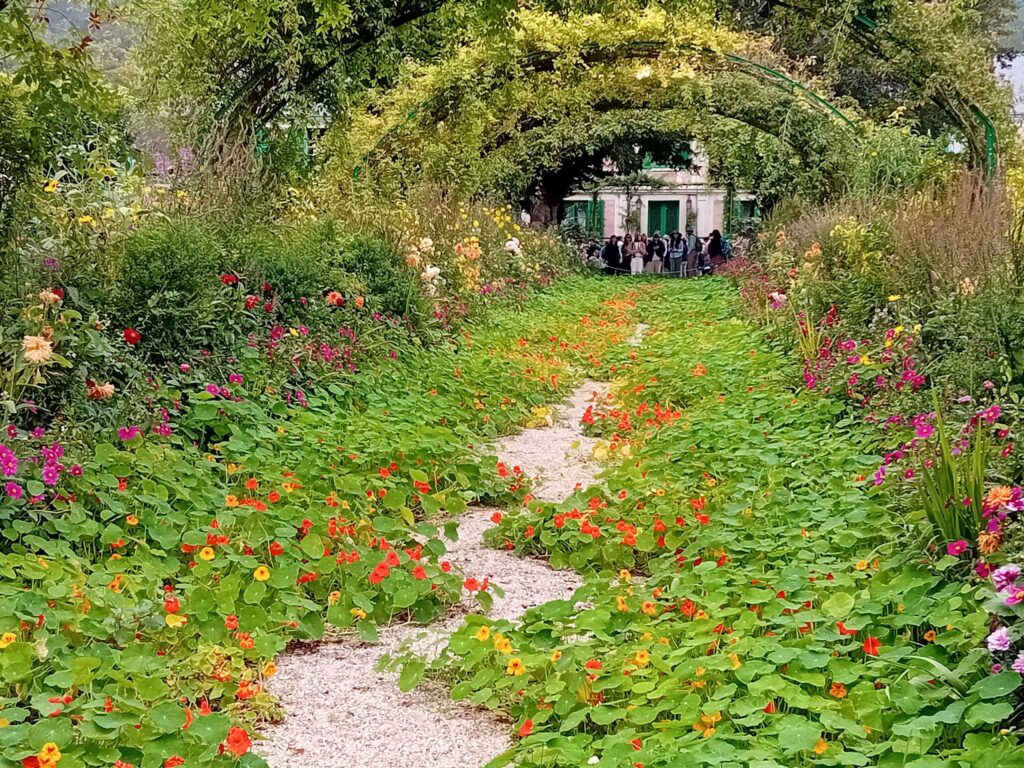
The Monet part of the Giverny site has three main sections; the house, the flower garden and the lily ponds, the latter accessed via a tunnel under the road. The house is charming (albeit that someone on Tripadvisor has complained that the Monet paintings displayed there are not originals) and overlooks the large flower garden, still profuse with colour in mid-September, immediately to the south. You can sense, if fleetingly, the pleasure Monet is likely to have felt when wandering around the paths or sitting on the terrace of the house with the garden stretching out below.
Further south again lie the lily ponds. It was a genuine thrill to see the water, the lilies (even if not in flower at this time of year) and the iconic green Japanese bridges in person. The banks are planted sensitively so that views of the water have varied and interesting foregrounds. Crowded it may have been, but I would not have missed it for the world.
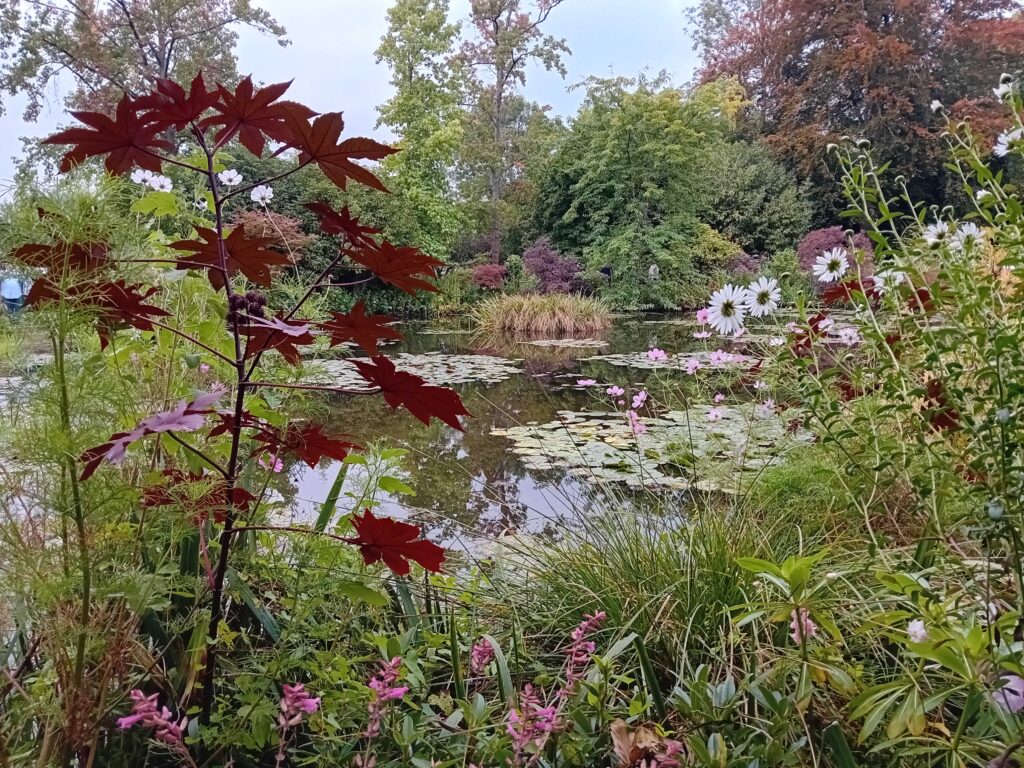
A lovely surprise awaiting outside the Monet section of the Giverny site was the series of beautifully planted, colour-themed garden rooms – white, blue, pink, yellow and more – by the contemporary building that houses the Museum of Impressionism. Most visitors appeared to bypass these altogether.
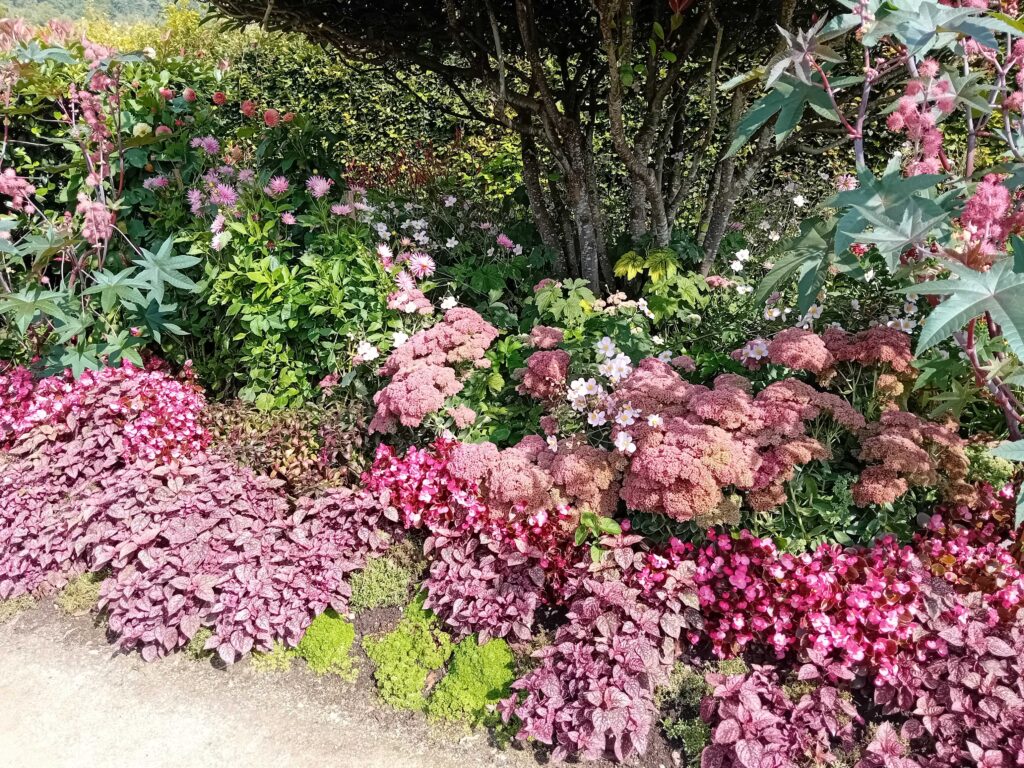
As an almost complete contrast to Giverny, we had been encouraged to visit Le Jardin Plume, close to the village of Auzouviile sur Ry and not far from Rouen. It is little-publicised (the owner of our accommodation had never heard of it), signposting is sparse and there is no car park other than the area at the entrance to, or alongside, the narrow track leading off the road. Thirty yards down that track is a small sign in the ground marking the entry point for pedestrians through a gap in tall hedging. There were no coach parties.
Passing through this portal reveals that the owners, Patrick and Sylvie Quibel, have created a wonderful variety of carefully designed garden rooms around a central meadow of prairie-style blocks and apple trees. A viewing platform provides an elevated perspective of the whole site; from there you can descend and immerse yourself in the various elements.
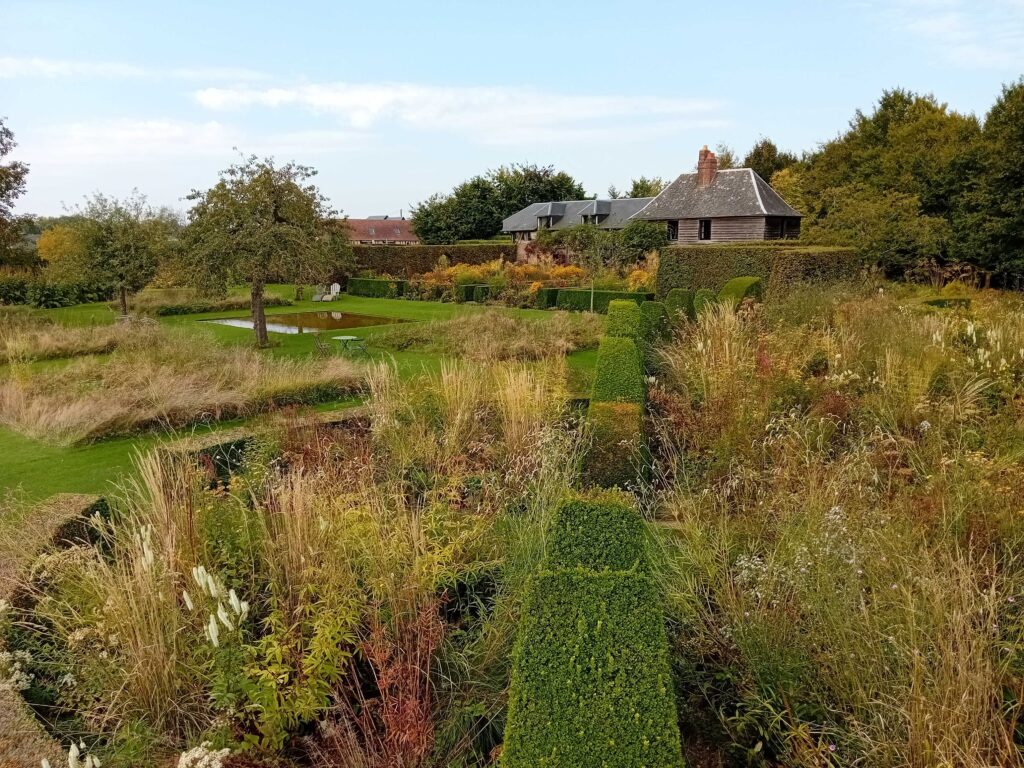
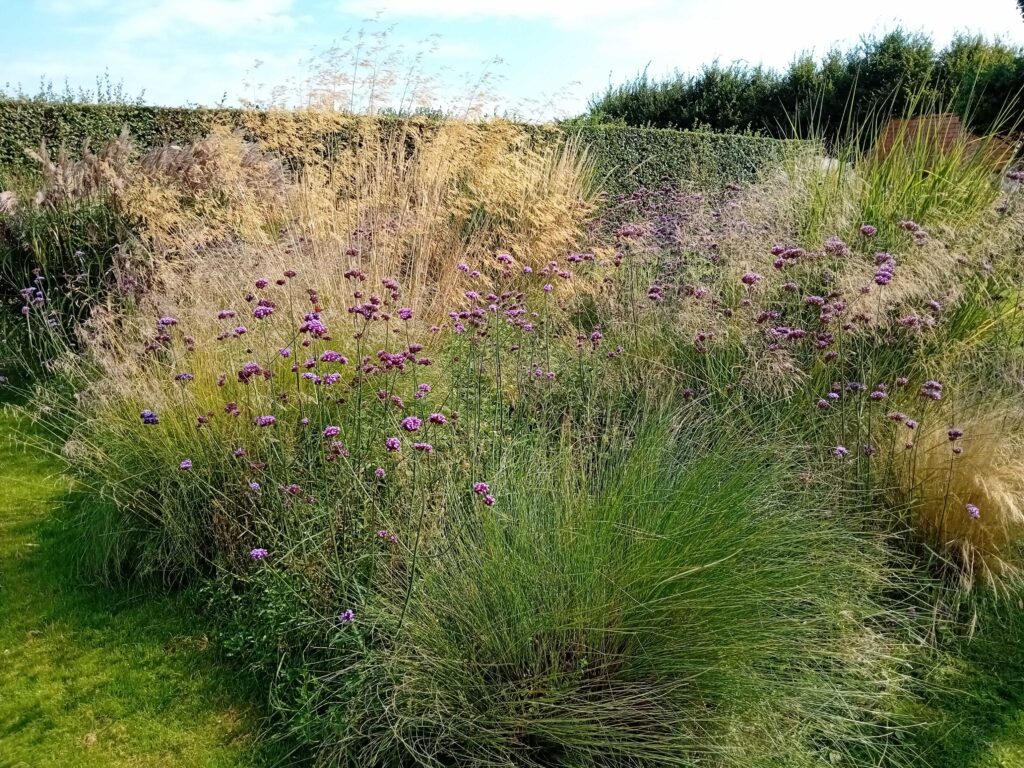
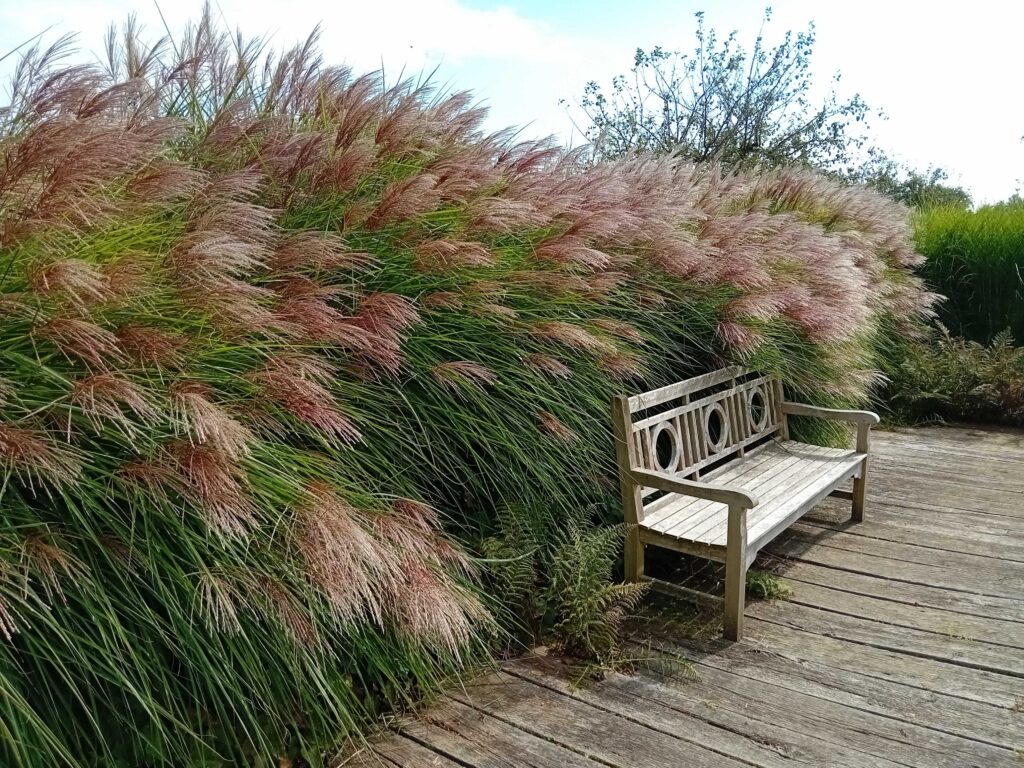
The garden is characterised by grasses, which produce the `feathers’ that give the garden its name, and depending on the `room’, herbaceous perennials within clipped and shaped box hedging. Some of the rooms have seasonal themes, so that the garden’s highlights evolve throughout the year.
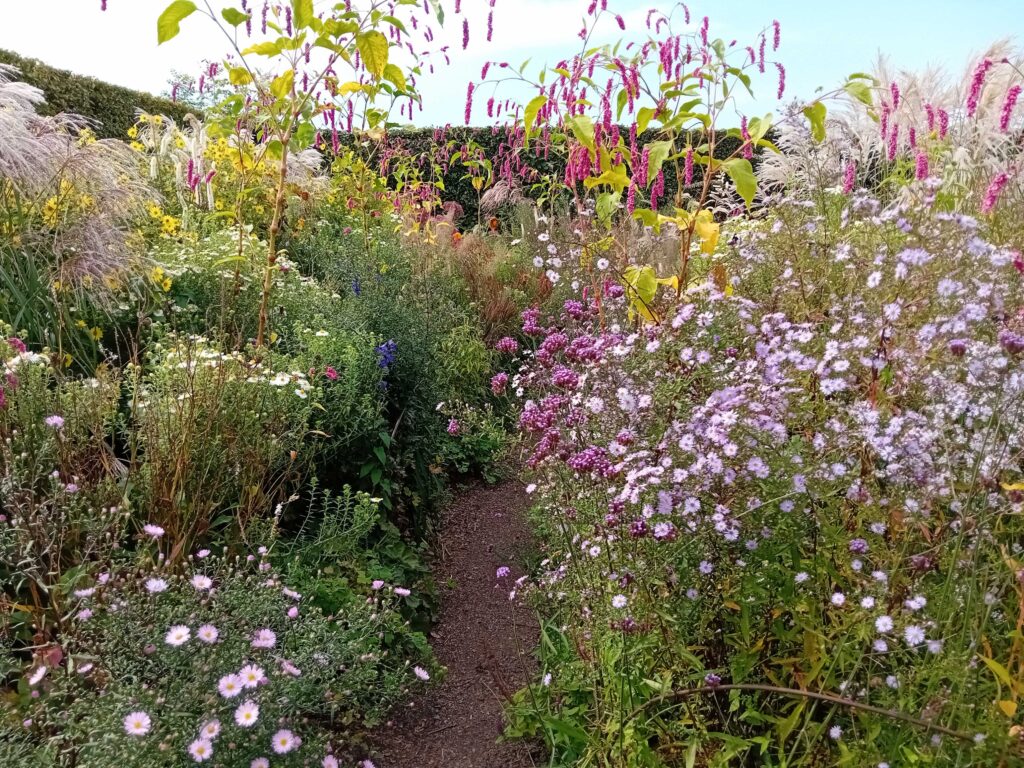
On our visit, the summer garden was still full of blooms. The autumn garden was already an especial delight. Surrounded by tall planting, we stood mesmerised as more peacock butterflies than we have ever seen in one place wandered and circled around us – a very memorable experience of a garden’s atmosphere.
Le Jardin Plume is an unusual, beautiful garden that turned out to be a highlight of our trip, as remarkable and admirable in its own way as, whilst also a complement and contrast to, Giverny. To have been able to visit both gardens felt somehow complete and very satisfying.
Article and photos by Paul Tosey
[1] Note: I believe the official (Académie des Beaux-Arts) website is https://claudemonetgiverny.fr/en/. There are websites with similar titles that sell tickets via agencies, which may charge booking fees.