
The Gardens Trust (GT) is a statutory consultee regarding planning applications affecting historic parks and gardens included on the register maintained by Historic England (HE). The overall aim of this work is to protect and conserve designed landscapes, which are `heritage assets’ for planning purposes.
A weekly list of applications notified to the GT is circulated to county garden trusts and, where these relate to Sussex, they are reviewed by the SGT Conservation Committee, which is chaired by Jim Stockwell. In addition, we sometimes learn of other applications from Local Planning Authorities, SGT members or other sources. During 2022 we have responded to some 15 planning applications and SGT comments are made available to the general public via the SGT website casework log.
The role of the Conservation Committee is to consider and comment on applications with regard to the significance of the site in question (i.e. its historic, archaeological, artistic and/or architectural interest) and the impact of the application. Applicants are required to describe and assess significance within their applications.
This case study concerns a recent example of a planning application by Leonardslee Gardens, near Horsham in West Sussex.
Leonardslee Gardens
Leonardslee is included on the Register of Historic Parks and Gardens with the highest designation, Grade I, reflecting the national significance of the garden and its world class collection of rhododendrons, camellias, magnolias and other trees. Between 1946 and 2010 the gardens were well maintained and open to the public. However, for the next seven years a new private owner took little interest in the gardens and their condition deteriorated badly. But in 2017 a new owner acquired the gardens and began major restoration work culminating with the gardens being re-opened to the public in 2019. This required significant investment and entailed many planning applications, including additional car parking. SGT has generally accepted these changes because they enabled the restoration and ongoing maintenance of the gardens, although some aspects have been resisted as out of keeping (for instance the design for a new kitchen garden).
Of those many applications, one made in 2021 is the subject of this case study.
The 2021 planning application
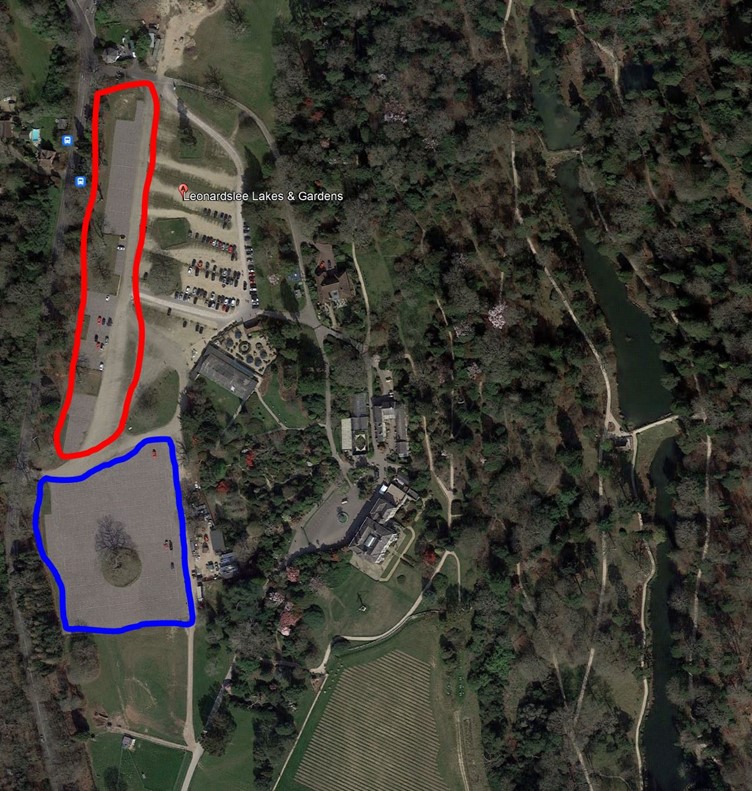
To help generate commercial income, numerous new activities are being introduced to attract a large increase in visitor numbers to Leonardslee. In 2020, to facilitate this expansion, a huge extension to the car park was built, but without planning permission. This increased the capacity of the car park from the 248 approved in 2019 to 724, nearly three times the previous capacity. The additional areas are shown circled red and blue below, left (planning permission for the area to the right of the area circled red had already been granted).
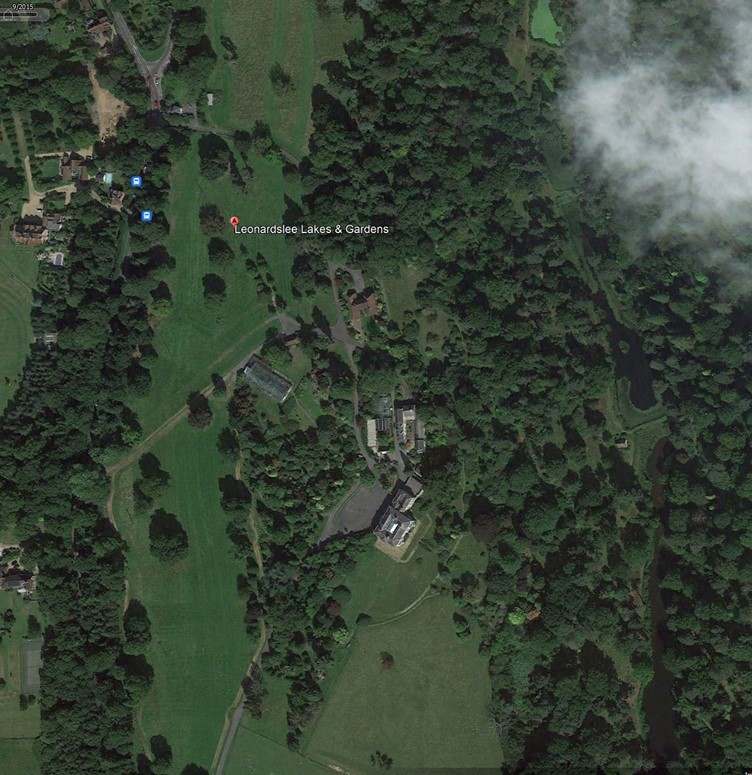
The construction of these new areas of parking has resulted in a vast area of unrelieved parking and hard surfacing across the former parkland seen in the image above, right, in 2015.
When a retrospective application for this work was submitted to Horsham District Council in August 2021, SGT carefully reviewed all the documents attached, but since these did not include the required assessment of the significance of the gardens or the impact of higher visitor numbers, an objection was submitted. The Trust also asked the Planning Authority to seek advice from Historic England, who later submitted an objection together with advice on what further supporting documents should be provided, especially a Conservation Management Plan.
During the autumn of 2021 some revisions were proposed by the applicant and the Planning Authority’s specialist advisors gave their assessments, which included many areas of concern. Particularly alarming was the report from the Arboricultural Officer who identified significant damage to mature veteran trees which had been caused by the way in which the new car park had been constructed. In the light of this and the fact that the Trust’s concerns had not been dealt with, SGT submitted a further objection in January 2022 as indicated in this extract:
Before the application is determined, it is imperative the applicant fully assesses the horticultural and arboricultural harm higher visitor numbers will cause and describes how this harm will be mitigated. If the park cannot accommodate higher visitor numbers without substantial harm, there is no justification for a larger car park.
In March 2022 Horsham District Council refused the planning application and their report on the application included these comments:
Historic England and The Gardens Trust have both expressed concerns regarding the harm that has resulted to this designated heritage asset, arising from the very large amount of unrelieved, highly visible parking and vehicular activity in an area of historic parkland and on the historic approach to the estate.
The submissions made in support of the application do not adequately assess the harm caused by the development to the significance of the registered park and garden or the main house, neither do they provide a clear and convincing justification for the amount of additional parking provided. In addition, the new parking has not been designed in a way to reduce harm.
The case was referred to the Enforcement department of Horsham District Council in the spring of 2022 and a new substantially revised application has very recently been submitted (Dec 2022). This removes the parking area circled red in the top image above and changes the area circled blue so it is used as an overflow car park on busy days, with gravel removed and grass seed sown so the area retains a green parkland character. In addition, the application provides for new tree and shrub planting to help break up the current vast area of unrelieved car parking.
Conclusion
This case study illustrates how the work of the SGT Conservation Committee has resulted in important and very welcome changes at this Grade I listed site. Our intervention has helped the owners and the Horsham District Council come up with a much better solution to the parking issues. However, there are still concerns that we will address when further comments are submitted towards the end of January 2023. In particular the applicant is planning to make Leonardslee a destination in its own right to attract a different type of customer visiting the café, restaurant, shops and special events which together are expected to attract around 400,000 visitors per annum. We will press Horsham District Council to require the owners to prepare a Conservation Management Plan showing how the impact on trees, shrubs and plants within the garden will be managed. SGT will monitor these developments in the months and years ahead.
As mentioned at the beginning of this article, the national GT is a statutory consultee for applications affecting all historic parks and gardens in England, but their resources are very limited and they depend on volunteers in local County Gardens Trusts such as SGT to undertake reviews in their counties. This represents a significant part of the work of SGT yet can easily go unnoticed. It provides an informed, independent voice that makes an important contribution to conserving and enhancing designed landscapes in Sussex. We greatly appreciate the assistance of SGT members and the general public, so please do let us know if you notice anything of concern at any site by contacting us here.
Article by Jim Stockwell, chair of SGT Conservation Committee