

Bates Green, Middle Garden © Patrick Campbell
I first encountered this artistic garden at the very end of 2001 when I decided that my current ballet teaching career was not fitting in well with family life. After reading an article about the WFGA (Working for Gardeners Association) I decided to join up and applied for a student role on the WRAGS (Work and Retrain as a Gardener Scheme).
Fortunately, I was offered an interview with the very talented plantswoman, Carolyn McCutchan, who had been living and gardening in the same location since 1968. Being a former dancer, I was immediately struck by the movement and flowing planting design of Bates Green Garden. Carolyn had put a great deal of thought into colour, light, shade and textural contrasts, resulting in a space full of atmosphere and interesting well-placed plants.
I trained in the Garden for a year whilst also studying at Plumpton College in Sussex. Carolyn was a very patient teacher – one of the very first things I learnt was how to recognise various seedlings in order to avoid weeding out the cherished self-seeders that characterise some areas of the Garden e.g. Digitalis, Lunaria, Smyrnium. Tree seedlings were also important; Corylus and Euonymus were often transplanted to more suitable spots or potted up to give away to grateful recipients.
We found that we had more in common than just a love of nature and horticulture; The Archers was a regular topic as were favourite food groups and recipes. Carolyn introduced me to the joys of the Hardy Plant Society; I absorbed so much from the meetings as well as filling my garden to capacity from the Plant Sales Table. I realised that one could not make a good garden unless you viewed others with a critical eye.
By the end of my training year, I had grown enough in confidence to apply for a job at Kew’s country garden, Wakehurst Place. I gained so much experience there, working initially with a small team to restore the Bog Garden, doing a stint in the Nursery and then gardening throughout all areas of this fabulously important conservation garden. This gave me a real passion for historical plant collections and I went on to work in other botanic gardens including the Chelsea Physic Garden – steeped in history.
Throughout those years I was a regular visitor to Bates Green Garden and I was sure to always bring my notebook. Carolyn was a font of knowledge: she conducted meticulous research before any plant purchase – no impulse buys for her! Something I have never mastered myself…….
Sadly, Carolyn became ill in 2015 and lost the energy to work in or even to think about her beloved garden. We stayed in touch; she still came to my house for lunch and she was never backward when commenting about my very unkempt ‘wild ‘garden. Carolyn’s husband, John, was always her loyal companion; he drove her everywhere and cared for her until she died in December 2019. They had been married for 56 years.
Bates Green Garden had suffered alongside Carolyn during those previous five years, it was neglected and overgrown, and its appearance was not helping John through his grieving process. I was by then teaching RHS qualifications at both Plumpton & Brinsbury Colleges and I offered to re-organise my teaching schedule so that I could work in the garden and start to restore it. This mission, despite COVID, snowballed as all good projects do and I invited some excellent ex-RHS students to come and assist me. They rose to the challenge and, together, we rediscovered its beauty and essence.
The Garden is divided into five main areas.

Visitors enter through the Front Garden, which comes alive in February with carpets of snowdrops, aconites and crocus. These are followed by hellebores and narcissus galore, all surrounded by stands of Cornus and Salix stems. The Wildlife Pond is a constant source of action, containing newts as well as aquatic plants. A towering Pinus sylvestris dominates the area; other trees such as Liquidamber, Parrotia and Cornus mas provide stunning autumn colour.

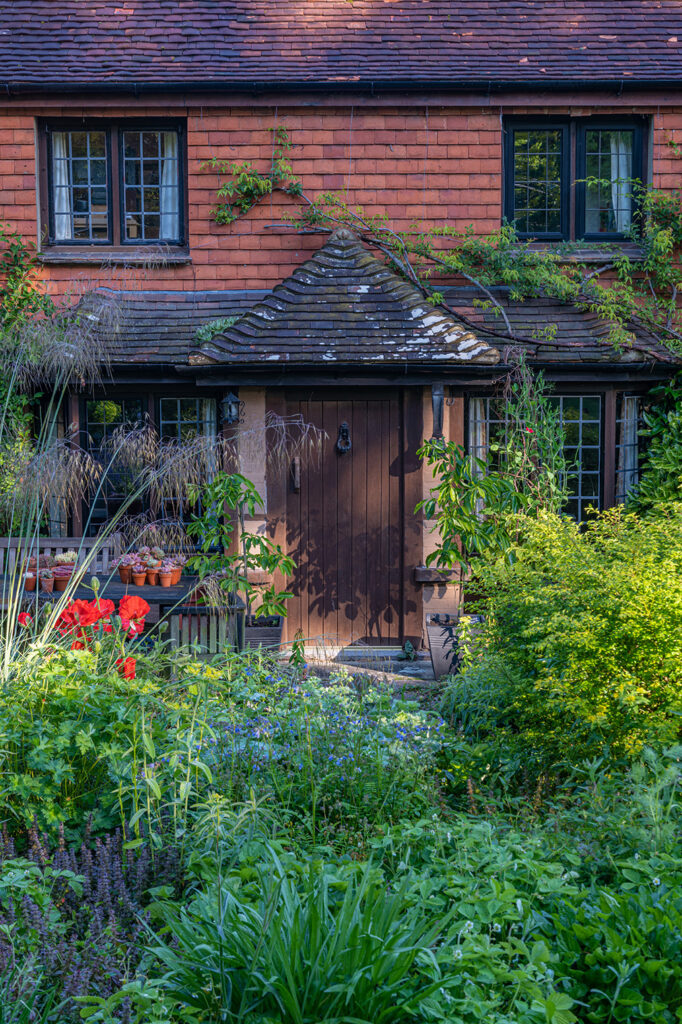
The Courtyard Gardens surround the former gamekeeper’s cottage where John was born. We use these paved areas to experiment with colourful and imaginative container planting and very well stocked borders surround all areas.
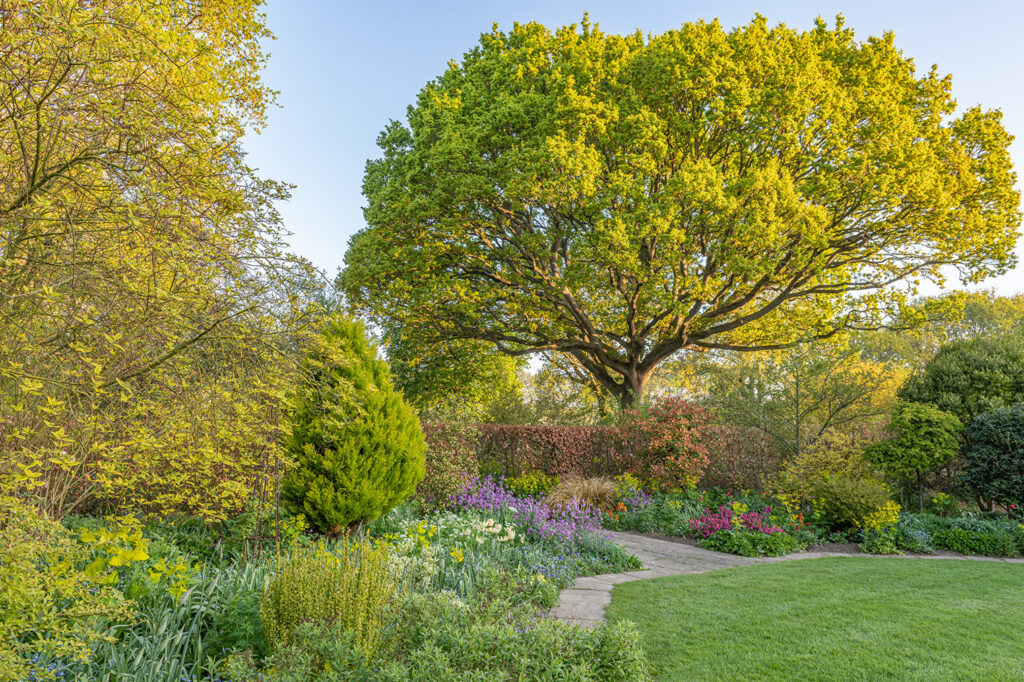
The Middle Garden has always been colour themed. Carolyn was a master of colour; her early influencers were the Canadian couple Sandra and Nori Pope who created harmonious and contrasting plant combinations. This part of the garden is now evolving as all gardens do. We are continuing the colour themes but have altered the plants to suit our changing climate.
The Woodland Garden has always been my favourite and I believe it was also Carolyn’s. Designed around a majestic English Oak, the shade loving plants provide texture and coolness in the heat of the summer.
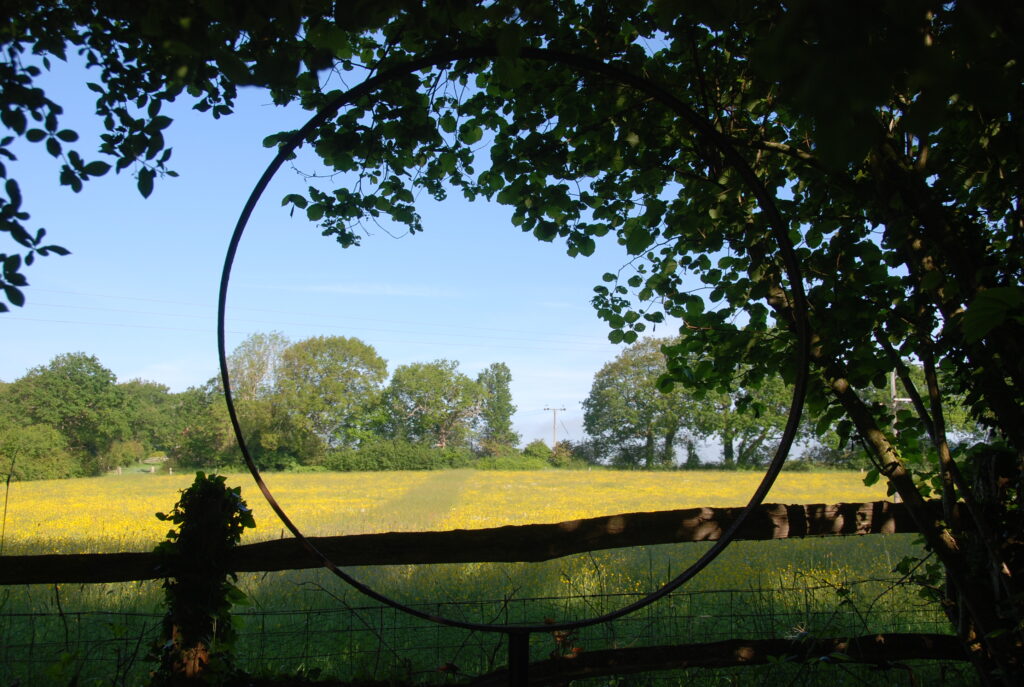
Finally, we come to the Wildflower Meadow. Managed by John under the Environmental Stewardship scheme, this 6-acre field comes to life in high summer and is a riot of colour and insect life. The mown paths permit close up studying of the flora and fauna and there are benches on which to ponder and admire the fine views of the South Downs.
It is an interesting process to develop a garden in the style of someone else. I feel, however, that Carolyn and I shared a love of gardening for nature and this is and always will be the theme of the garden. We garden organically, leaving heaps and piles for creatures to inhabit, and the hedges are cut only at appropriate times of the year. We are proud of our homemade compost, and reuse and recycle as much as we can. For example, Carolyn planted a Hazel Walk in the year 2000 and we coppice one third of these stems annually for plants supports and structures, Cornus and Salix stems too.
Our newly acquired RHS Partner Garden status is an accolade to Carolyn and her dedication to horticulture. My well-thumbed Bates Green Garden notebooks have proved to be more useful than I would ever have imagined.
Article by Emma Reece, Head Gardener