
The Hidden Horticulturalists: the working-class men who shaped Britain’s gardens
Fiona Davison. Published by Atlantic Books Ltd 2019
Hardback ISBN 978-I-78649-507-5 £25. 2022 Paperback edition. £10.99
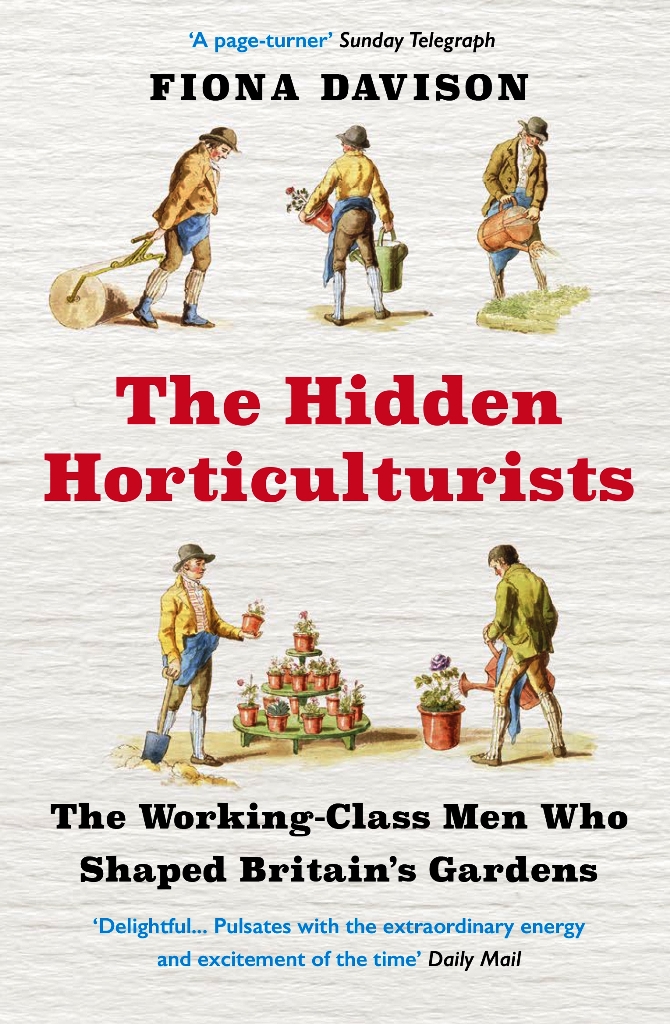
An unexpected find of a box labelled ‘Handwriting Book’ in the Lindley Library has led to this remarkable book by Fiona Davison, who began her career in the archive and library in 2012. Inside the box were handwritten letters by young gardeners aspiring to further their careers by gaining experience at the Chiswick Garden of the Royal Horticultural Society. The letters were dated from 1823 and each applicant had to be sponsored by a Fellow of the Royal Horticultural Society. In their handwritten letters they detailed their careers to date and the type of gardens they had been working in, requiring as wide experience as possible to be accepted into Chiswick. There were 105 of these letters and setting out to trace the applicants took Davison three years travelling in England and around the world.
The gardener, John Lindley, was appointed to be in charge of the collection of plants at Chiswick when he was 23, and having studied botany advised these young gardeners to further educate themselves by forming a Mutual Improvement Society. Another garden designer who encouraged the young men was John Claudius Loudon and he wrote of the progress of the Horticultural Society in The Gardener’s Magazine, first published by Loudon in 1826.
Among the notes was one from Joseph Paxton who began studying at Chiswick in 1823, sponsored by Joseph Sabine, and allowed admittance by declaring he was born in 1801 and not 1803 so as to claim two additional years of schooling. About two years into his training, whilst he was in charge of the arboretum at the Chiswick Garden, he was befriended by the Duke of Devonshire, whose land was adjacent to the garden and in March 1826 the Duke offered him the post of Superintendent of the Gardens at Chatsworth. Paxton’s meteoric rise to fame had begun.
There were few openings at large gardens for head gardeners, and some did not fulfil their potential. John Reicks arrived at Chiswick in 1828 coming from Castlecomor in the County of Kilkenny and was discharged after a month’s trial. In the mid-1830s he was working for Miss Mary Driver at Hawthorne Cottage, Framfield, East Sussex, as live-in gardener and handyman together with his wife Anne, who was the cook.
Other trainees from Chiswick took their careers in different directions, some becoming plant hunters and collectors. Thomas Bridges was one of these and under the tutelage of John Lindley studied botany and plants sent back by the Society’s plant collector James McRae from Brazil, Chile, the Galapagos Islands and Hawaii. Thomas Bridges aspired to go to Valparaiso in Chile and having collected enough sponsors to pay for his voyage he arrived in August 1828. His voyage has been traced by the letters he wrote to William Hooker, the well-known scientist, now kept at the Royal Botanic Gardens at Kew.
Some of the young men were lucky enough to procure employment abroad. James Traill and William McCulloch were recruited to work for the son of the viceroy of Egypt, Ibrahim Pasha, to create a new garden. McCulloch was sent to India to source new plants for Egypt and James Traill introduced plants sent by the Horticultural Society. This was only partly successful due to the climate and McCulloch moved to Bombay to continue his career. When Ibrahim Pasha died Traill worked for Soliman Pasha and spent the rest of his life in Egypt.
In 1861 another horticultural garden opened which eclipsed the Chiswick Garden and led to the demise of the training scheme at Chiswick. This was the RHS Kensington Garden, financed by profits from the Great Exhibition and promoted by Joseph Paxton. Proving too expensive for the RHS to continue funding, in 1888 the lease on the Kensington site was terminated and attention was again focussed on Chiswick. The society sought a larger garden beyond London and in 1903 Sir Thomas Hanbury gave Wisley in Surrey to the society.
The goods and chattels at Chiswick were put up for auction and the Handwriting Book made its way first to Wisley and eventually to the Lindley Library where it was discovered by Fiona Davison in 2012.
This detailed account of many of the gardeners who were admitted to Chiswick is a delightful read, fully illustrated with drawings and colour plates from the RHS Lindley Collections.
Review by Lynn Gausden