
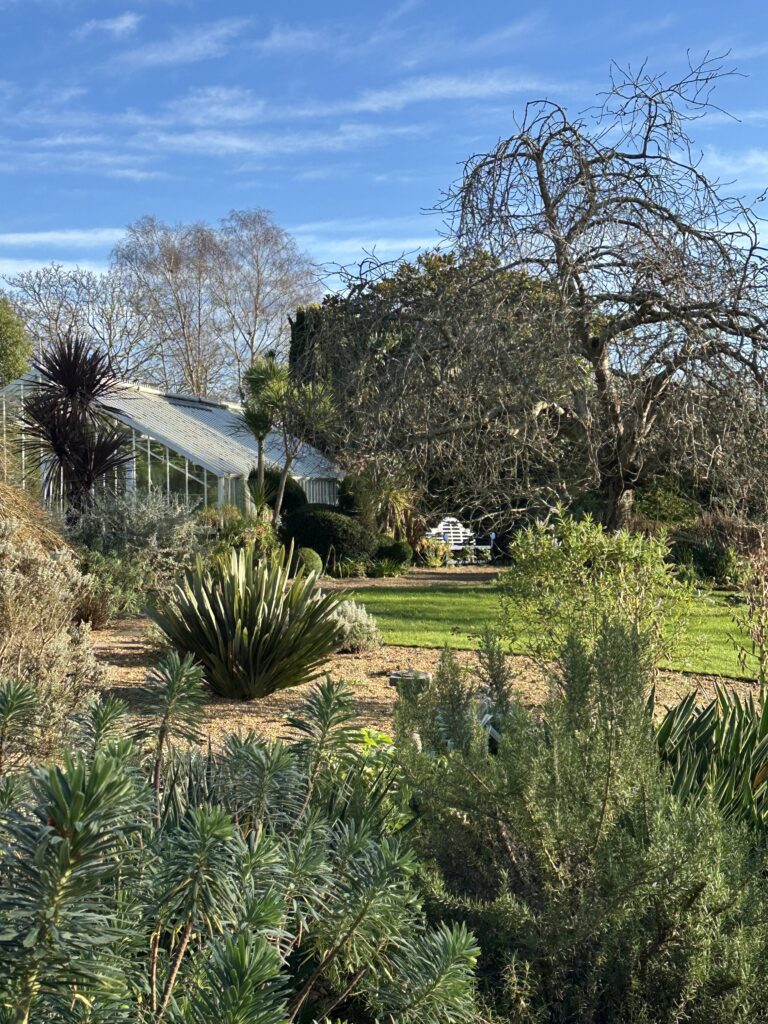
Apricity is an old English word for the warmth of the sun on a winter’s day – not easy to drop into conversation – but it seemed appropriate on a crisp and bright day in early December, when I joined a ‘Winter Stroll through the Garden’, at Denmans, in West Sussex, led by the owner, Gwendolyn van Paasschen. With the low sun creating welcome patches of warmth and accentuating the evergreen topiary, paper-white birches, and silhouettes of stems and seedheads in the borders, the garden revealed a distinct winter beauty.
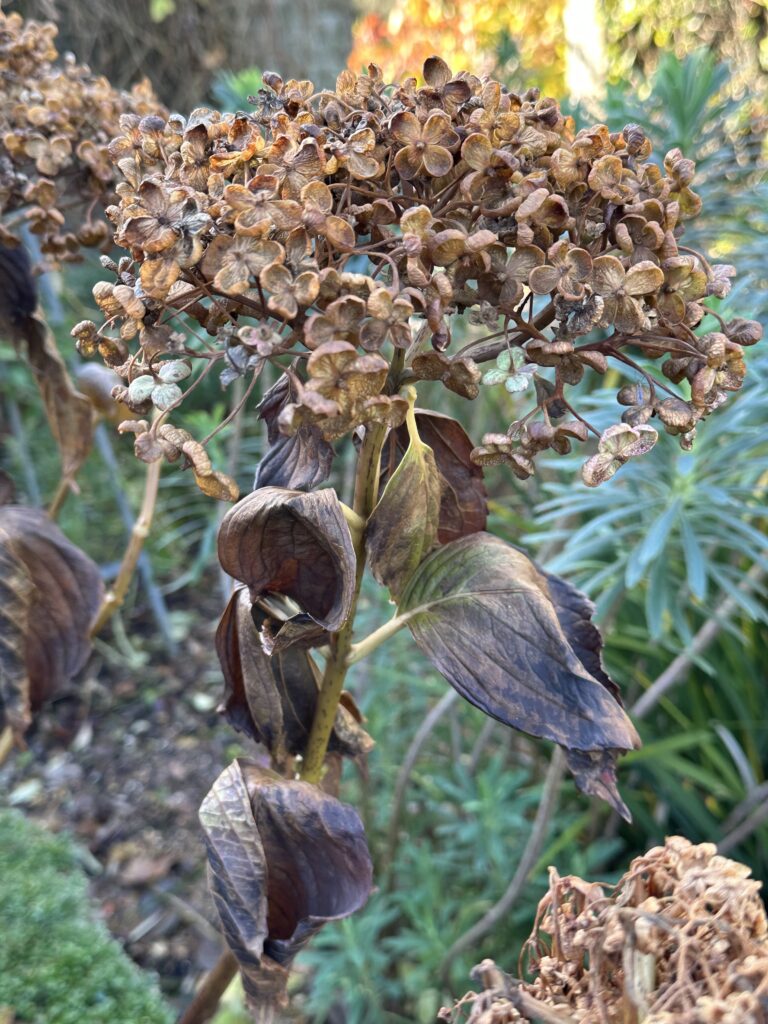
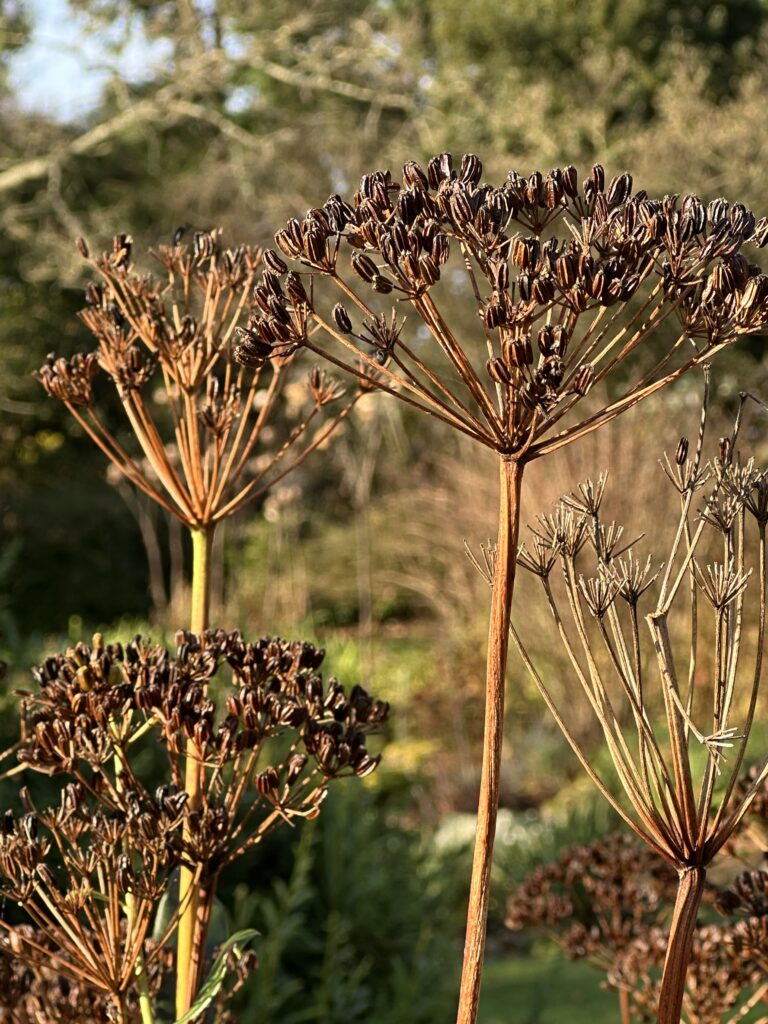
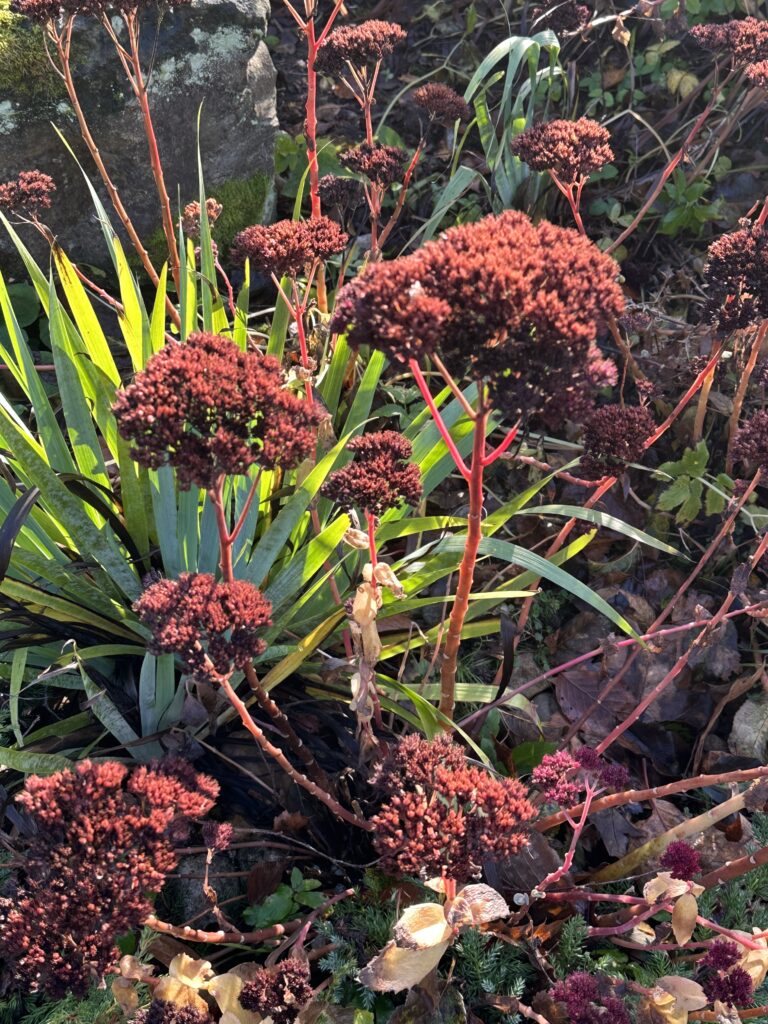
The first owner and creator of Denmans, Joyce Robinson, began planting trees ‘boldly’ as she said, with a redwood, Metasequoia glyptostroboides, and a maidenhair tree, Ginkgo biloba, followed by evergreen shrubs like the variegated Eleagnus ebbingei, daphnes and skimmias. In winter these strong shapes give the garden its structure, and provide contrast to the spiky dried heads of Valerian officinalis and filigree clusters of Hydrangea arborescens ‘Annabelle’. There is still colour in the garden but less summery, more like a moody Mark Rothko painting: dark maroon flower heads of the sedum, intense purple of kale in the flower border, and then looking carefully among the fallen leaves, bright splashes of crimson from almost-hidden cyclamen.

From 1952 when Joyce Robinson began the garden at Denmans, through to the arrival of John Brookes in the 1980s, it is a garden that has constantly evolved, yet retains the philosophy of its first owners. Gwendolyn has continued to develop the planting, most recently creating the Nut Walk, which meanders through shady hazels and acers, from the lower garden around to the gravel garden by the cottage. Surprises appear as this work goes on: snowdrops for example, which John Brookes never wanted anywhere in the garden, are emerging beneath the trees, perhaps as a testament to Mrs Robinson.
These discoveries are a reminder of creative connections between the earlier garden designers. Brookes met Joyce Robinson when he brought his students to one of her NGS days – she started opening the garden in 1967 – and from this meeting he moved to Denmans in 1980 and founded his School of Garden Design, eventually making it his home.
It was perhaps a lucky chance that Brookes apparently found Christopher Tunnard’s book Gardens in the Modern Landscape in a junk shop as a teenager, and decided to follow horticulture as a career. He began working with the landscape architects, Brenda Colvin and Sylvia Crowe, later taking a job as Colvin’s assistant, before starting his own practice. By 1962 he had been awarded a silver medal for a Modernist design at the Chelsea Flower Show, aged just 29.
Colvin and Crowe had been founder members of the Landscape Institute, together with Geoffrey and Susan Jellicoe, who guided the young Brookes, introducing him to artists, architects and designers, and taking him to exhibitions, concerts and the opera in London. The Jellicoes were part of a rich network of creative personalities: Barbara Hepworth, Ben Nicholson, Berthold Lubetkin and Ove Arup, and Brookes undoubtedly gained from their support. The curving shapes of the borders and river beds which he developed at Denmans were influenced by the work of the Brazilian landscape designer, Roberto Burle Marx and on one occasion John met his hero at the Jellicoes’ home in Highgate. Geoffrey and Susan Jellicoe included the work of Brookes in their book Modern Private Gardens, published in 1968, and in a private letter to John, Susan wrote that he was one of the young designers on whom they had their eye.
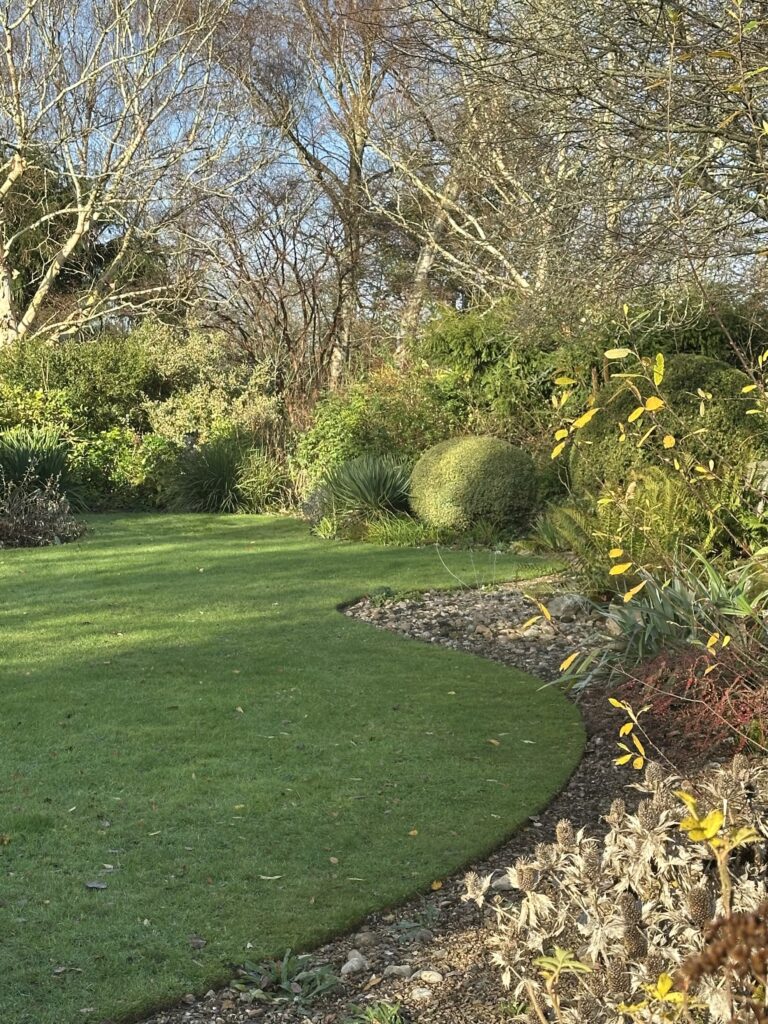
Brookes is widely acknowledged for making popular the concept of ‘the room outside’, which became the title of his ground-breaking book in 1969, where he writes of the garden as no longer a set piece for showing off plants, but as ‘a place for use by people’.
The idea of the modern garden as an extension of the house appeared in an earlier publication, The New Small Garden,co-written in 1956 by Susan Jellicoe and her colleague at the Institute, Marjory Allen, featuring thirty-two small gardens, many of which belonged to their friends, photographed by Susan. The gardens were chosen to show how good design could ensure that the smallest space could have places to be enjoyed by all the family, and even extend its boundaries by making ‘an outdoor room… an additional room, without a ceiling’. For landscape architects working in the post war period finding new approaches to the design of a smaller garden became a significant part of their work – an idea that Brookes developed with modern affordable materials and styles.
Denmans is one of the sixty unforgettable gardens specially selected for inclusion by the Gardens Trust for a new book Unforgettable Gardens – 500 Years of Historic Gardens and Landscapes.
The role of women in post-war landscape architecture is the focus of an upcoming series of online lectures organised by FOLAR and the Gardens Trust. The talks consider six women who contributed to the expertise, development and awareness of the landscape profession and in so many different ways: Susan Jellicoe, Sheila Haywood, Brenda Colvin, Mary Mitchell, Marjory Allen and Marion Thompson. The first talk is about Susan Jellicoe, 8 January at 6.00 pm, and tickets can be booked here.
Article and photos by Sally Ingram.