
In late October, 2023, I travelled to France with friends through the Loire valley and down to the Charente. To break our journey on the way back to Calais we stayed at Chinon and visited not only the medieval fortress at Chinon but the beautiful later renaissance château and gardens at Villandry. The weather was still reasonably good, although autumnal, some downpours of rain, but it was thankfully before storm Ciarán hit northern France and the UK.
There had been a fortress on the Villandry site since the twelfth century. However, in the sixteenth century this fortress was pulled down, all except the old Keep, and a new owner, Jean Le Breton, built on its footprint. He created a new Renaissance château complete with formal French ornamental and vegetable gardens. In the eighteenth century another new owner, the Marquis de Castellane, brought it into his own century by adding more windows, enclosing courtyards and adding out-buildings. He also purchased land from the village stretching up to the twelfth century church and so increased the size of the gardens. He built viewing terraces and a pond in the shape of a Louis XV mirror, fed from an existing stream. Owners came and went, including Napoleon’s younger brother, but when in the nineteenth century it was bought by a financer, Pierre Hainguerlot, the intricate classic gardens were swept away and replaced by the then fashionable open park in the English style.
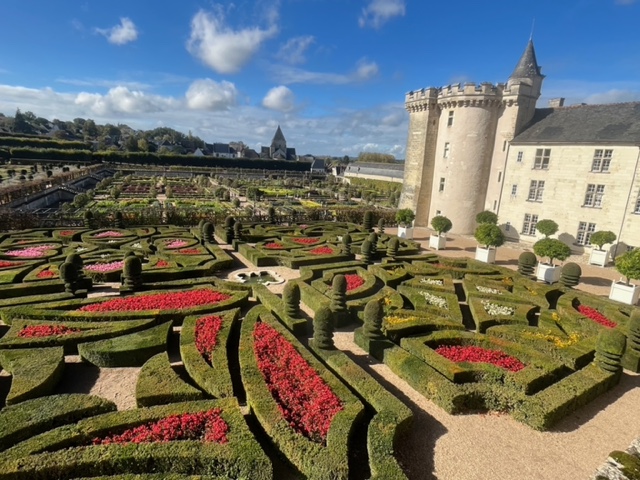
It was not until the early twentieth century that everything changed yet again for Villandry. The estate of 17 ha (42 acres) was bought by the Spanish born scientist Dr Joachim Carvallo and his wife Ann Coleman, an American steel heiress. Carvallo was determined to return the château and its gardens to its original Renaissance beauty, and this he spent the rest of his life doing. Today, his great grandson Henri Carvallo owns and manages the château and estate.
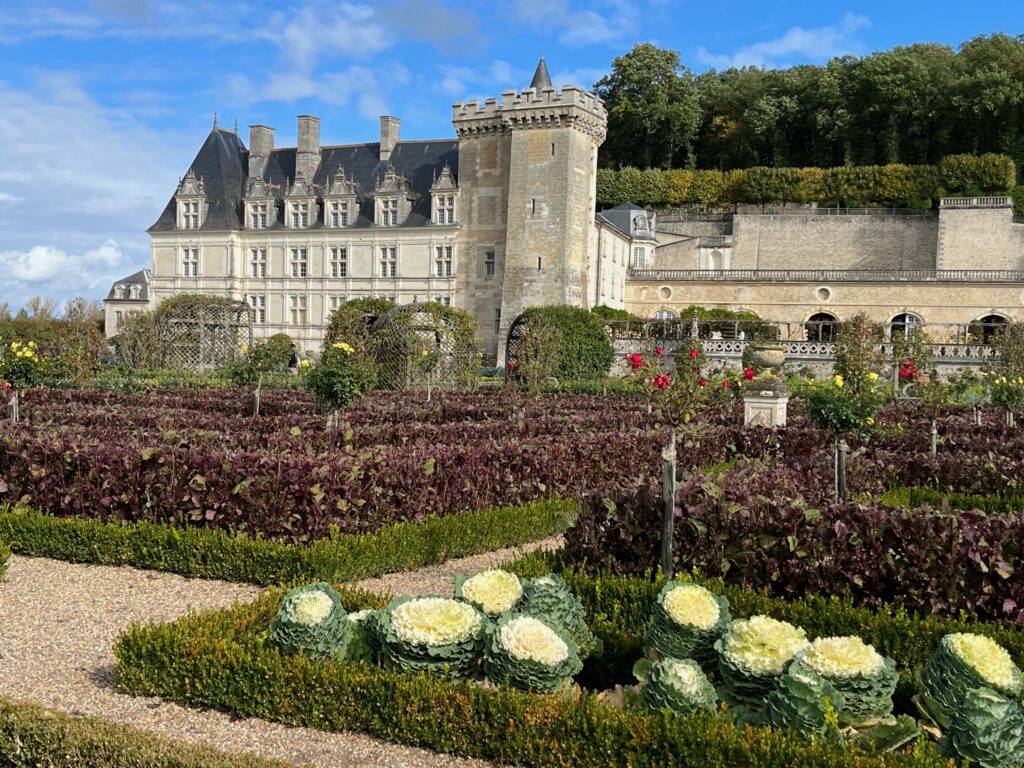
The intricate French classic gardens are best viewed from above so that one can appreciate the design, meaning, colour and crispness of the individual beds. Thus, both the ornamental and vegetable gardens are close to the château and can be viewed from the large windows on the south side. There are also three levels of terraces shaded from the summer sun by lime trees overlooking the gardens. Near the vegetable garden the paths are lined with climbing vines, again for shade. A canal runs from the pond through the ornamental gardens and around the south west of the château feeding a moat. Fountains are also in evidence with smaller ponds as part of the design.
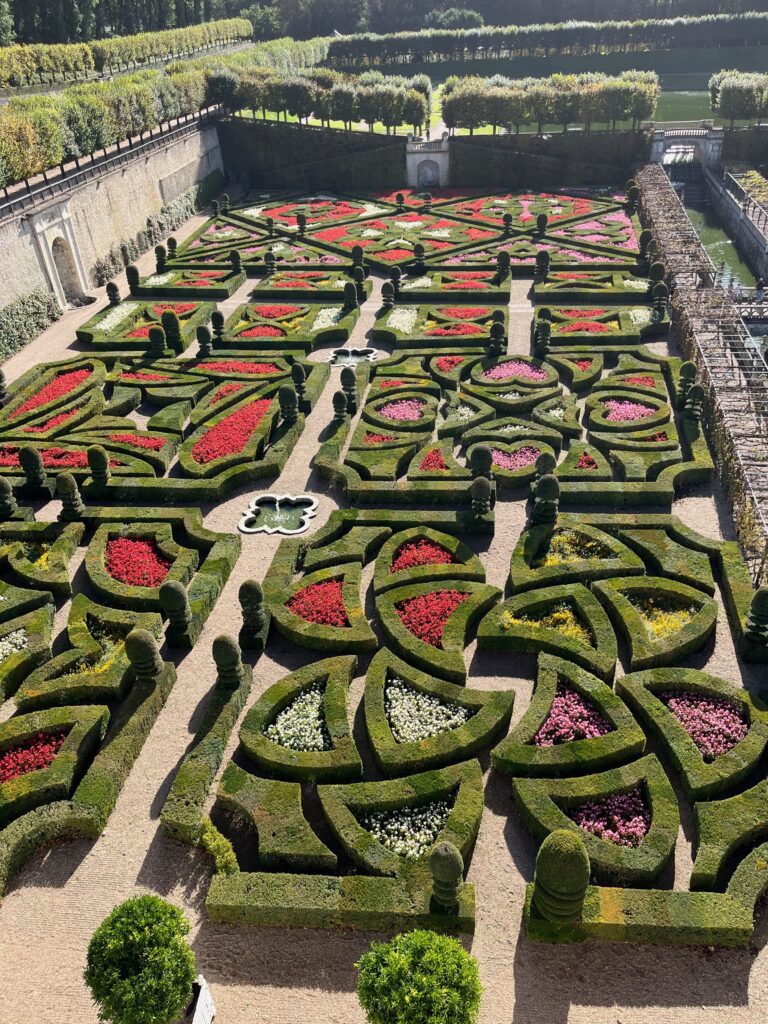
Leaving the château, we walked on terrace paths towards the ornamental gardens, which are the ones Villandry is so well known for. These consist of areas of closely clipped box hedging and shaped yews enclosing annual ornamentals that are replaced twice a year, tulips and forget-me-nots in spring and begonias in summer. One cannot walk amongst these beds as they are roped off and people would clearly spoil the pattern so one has to keep to the wider paths and terraces. The garden immediately in front of the château to the south east is the Love Garden and the box hedging is patterned in four sections to symbolise tender love, passionate love, flighty love and tragic love. Only in France! Beyond this garden is the cross garden with the hedging representing crosses from Malta, Languedoc and the Basque country, and beyond that the music garden with instruments and candelabra shaped in boxwood. One wonders how the box hedging is surviving the box tree caterpillar given that from 2009 the garden has been organic, but no doubt nematodes are used.
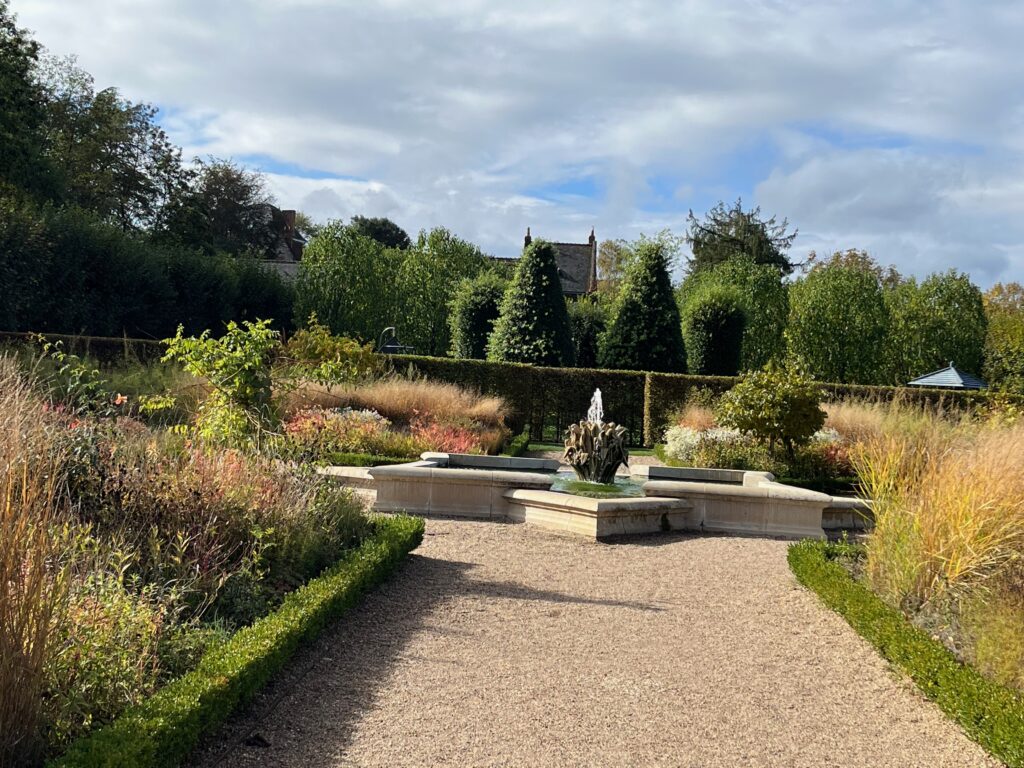
At the far southern end on the third terrace before reaching the forest and greenhouses, there is a water garden with large mirror pond, lawns and fountains. It is a peaceful place surrounded by lime trees with a path leading to the Sun Garden. This garden was completed in 2009 based on an original design by Joachim Carallo. It has in its centre an eight-pointed star pond and is surrounded by modern perennial planting.
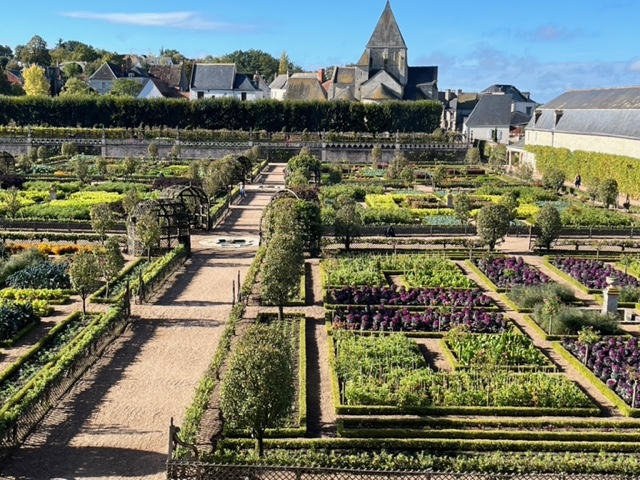
From this garden we walked back down towards the château and the café through the vegetable gardens. Although not at their best in late autumn we noted the pumpkins, white cabbages, capsicums and darker perill, an Asian herb. We also saw a couple of gardeners at work on one of the beds. There is a team of ten gardeners and no doubt they are kept very busy as the work needed to keep all the gardens looking so immaculate must be huge. It is quite a unique garden in a beautiful setting so my friends and I came away thinking how nice it would be to see it in spring, and maybe summer as well. Lots of trips to France is not a bad ambition!

Reference has been made to the château guide book ‘Castle Villandry and Gardens’ ,editing and words by Caroline Piat. English translation.
Article by Maggie Weir-Wilson