
It is surprising just how much history of a garden can be gathered from the accounts left behind by visitors. Ephemera like the pages in a diary, a postcard to a friend, jottings in a notebook, photographs pasted in albums, all personal recollections that can help interpret or reconsider the past. A photograph from the 1920s of an impressive sundial among cottage-garden flower borders and topped by a pelican, its wings outstretched, prompted a closer look at an artist’s garden in Lindfield.
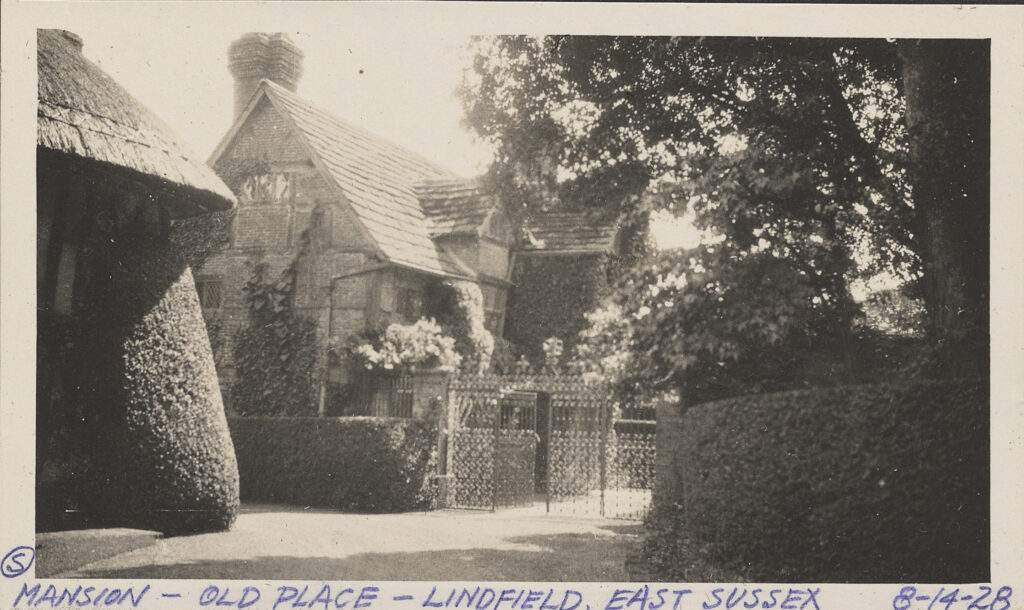
The Pelican Sundial was photographed by Sam Brewster, who with his fellow student Loyal Johnson, arrived at Old Place in Lindfield in August 1928, on their cycling tour of British gardens. Old Place was then owned by Sir Rupert Clarke, an Australian entrepreneur, who frequently visited Britain and had two houses in England, one in Hampshire and one at Old Place in Lindfield, but the pair were shown around by the gardener, Mr Elder. Admiring the old-fashioned planting and neat yew hedges, Loyal wrote in his diary about a bridge, similar to one he had seen as Polesden Lacy, and resembling a garden house, that disguised a public right of way: ‘a sort of tower of very unusual and striking design done by some former owner or someone of that kind’. The ‘someone’ would have been Charles Kempe, artist and designer of stained glass, who bought Old Place in 1875 and the garden house with the tower was his studio.
Born in 1837, Charles Kempe had studied at Pembroke College, Oxford, and intended to take Holy Orders but was deterred by a speech impediment. Instead, he discovered an interest in art and architecture – perhaps influenced by one of his relations, Thomas Kemp, responsible for Kemp Town in Brighton in the 1820s. Charles added another ‘e’ to his name and formed his own business, Kempe and Company, to make stained and painted glass.
Kempe extended the property and landscaped the 200 acres with a view through to the village church, creating a secret garden, and a wilderness. The sales particulars of 1925 describe the garden with a bowling alley, a privy garden, herbaceous borders, a lime avenue, and ‘fine old lawns’. Kempe was by all accounts a popular host, fond of dressing up and providing fancy dress costume for his guests, and William Morris and Henry James were frequent visitors. One close friend apparently said of him: ‘I do like Mr Kempe. I have a warm regard for him, almost an affection. I don’t agree with him on any point. But I like that he should be there’.
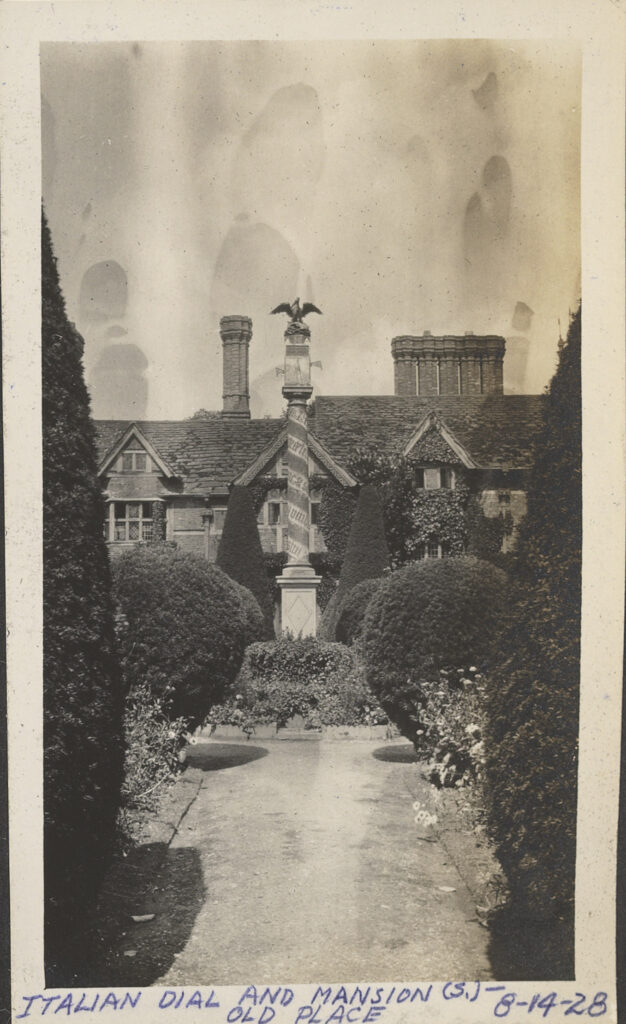
The imposing sundial that Sam Brewster photographed was about seventeen feet high, surmounted with a bronze pelican and with three dials, to the east, south and west. Loyal Johnson might have asked his friend to take this particular photograph, having written a history of sundials: ‘their construction and present day use’ in March 1928 while a student at Massachusetts Agriculture College. The closely typed pages describing classifications, meridian planes and materials for making sundials are not for casual reading – Loyal tried to get his research published but was rejected. The more interesting ideas come towards the end when he suggests how sundials could bring pleasure to public parks, with ‘endless opportunity for new and interesting designs, arrangements and combinations’, such as using edging plants to design the dial, or placing rust proof metal below the surface of a pool so the shadow of the gnomon would be cast on the surface, all ‘well within the limits of possibility’.
One of the books that Loyal Johnson includes in his bibliography is Sun Dials and Roses of Yesterday by Alice Earle and published in 1902. This is a wonderful collection of anecdotes, sketches, photographs and poetry about sundials, and sometimes roses – ‘the placing together of two garden delights’. She writes of the ‘brooding pelican’ at Old Place, in bronze, on top of a tall pillar, inscribed with a spiral of black and gold letters a Latin motto, which she transcribes as:
Time flies, suns rise and shadows fall
Let time go by. Love is forever over all.

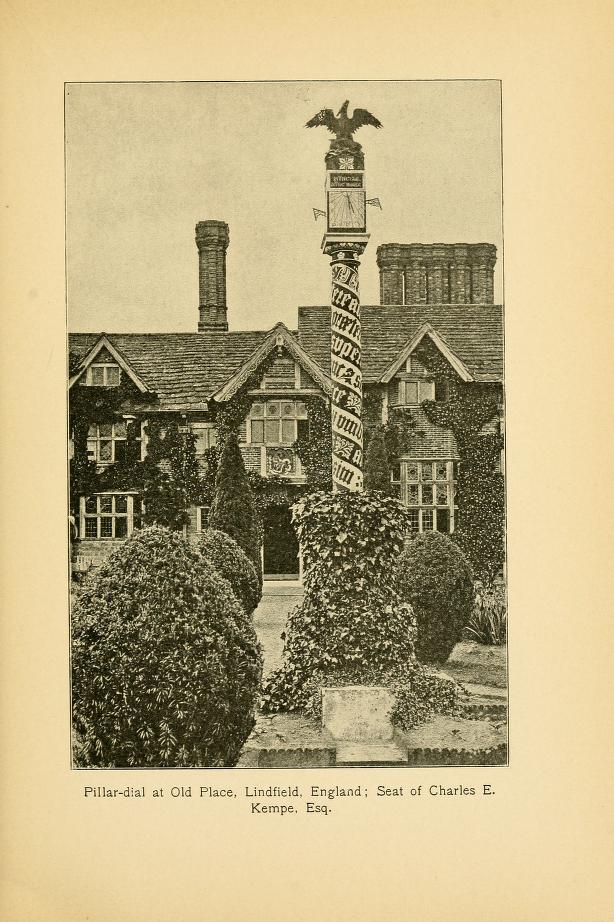
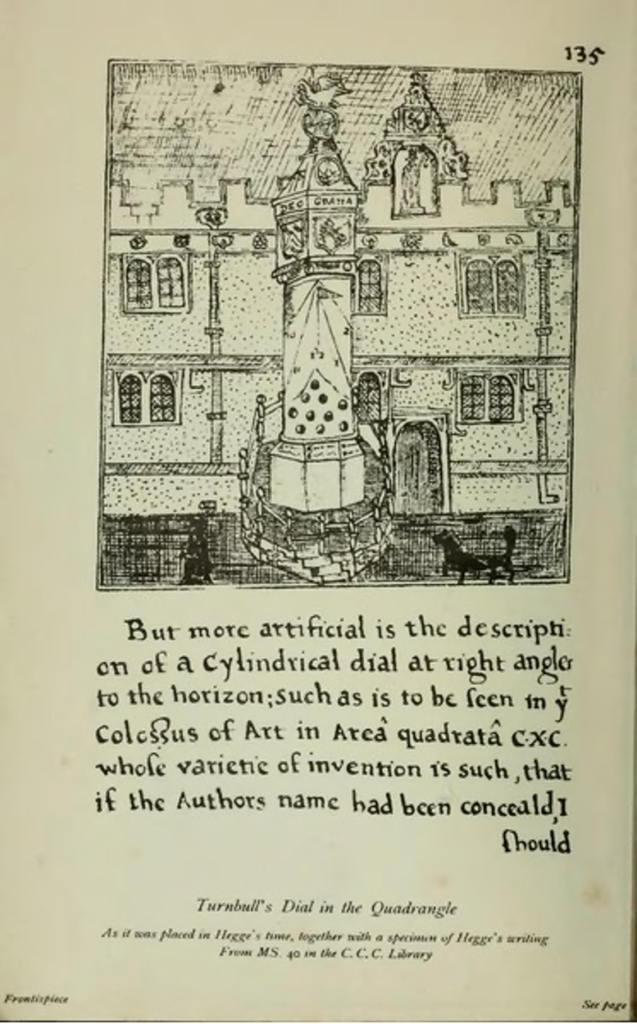
It is thought Kempe had perhaps a dozen sundials in his garden and in his home. In the bedroom, known as the Dial Room, there were stained glass sundials in three windows, which he could read while in bed, but the most fascinating was the Pelican. Although some accounts give Pembroke College as the influence for the Pelican, Kempe would have seen the Turnbull Dial, over twenty-five feet tall and surmounted by a pelican, at Oxford in the Front Quad of Corpus Christi College, erected between 1579 and 1581.
The historian, Phillip Pattenden, is sure that Kempe’s dial is inspired by ‘The Pelican’ at Corpus, although a simplified version. Sam Brewster ascribes ‘Italian’ to his photograph of the Pelican but it is more likely to have been made in Sussex, by Norman and Burt of Burgess Hill, or perhaps Farmer and Brindley of London.
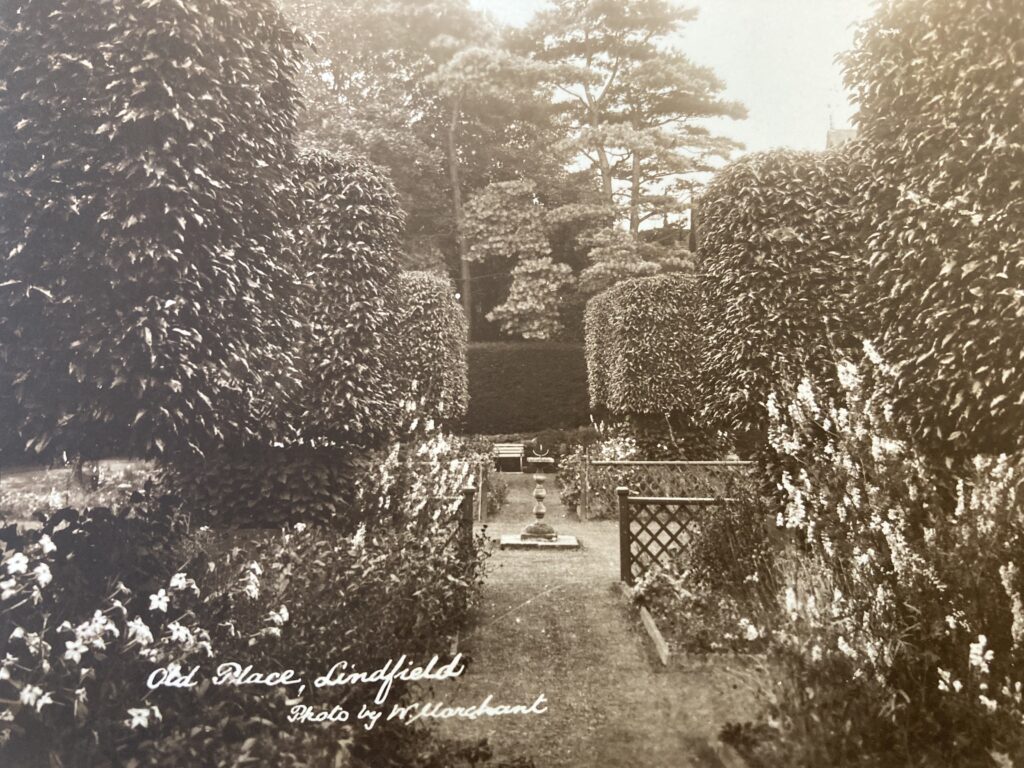
Sundials frequently appear in the paintings of Victorian flower gardens and the artist Ernest Arthur Rowe made several water colour paintings of Old Place, including one of the sundial, shown at the end of a grass path, offset by the clipped yews and borders of colourful cottage-garden flowers.
Apart from articles in Country Life, which describe Old Place as the ‘most beautiful and artistic abode with clipped yew hedges, tall growing lilies and irises’, it is accounts, such as that of Alice Earle, and recollections of visitors that offer most of what is known about the garden. Frances, Viscountess Wolseley, first met Kempe in October 1890 when she was invited to Old Place. Lindfield, she wrote, was ‘where the neighbouring gentry of the countryside, had in Elizabethan and later centuries, spent the winter months’.

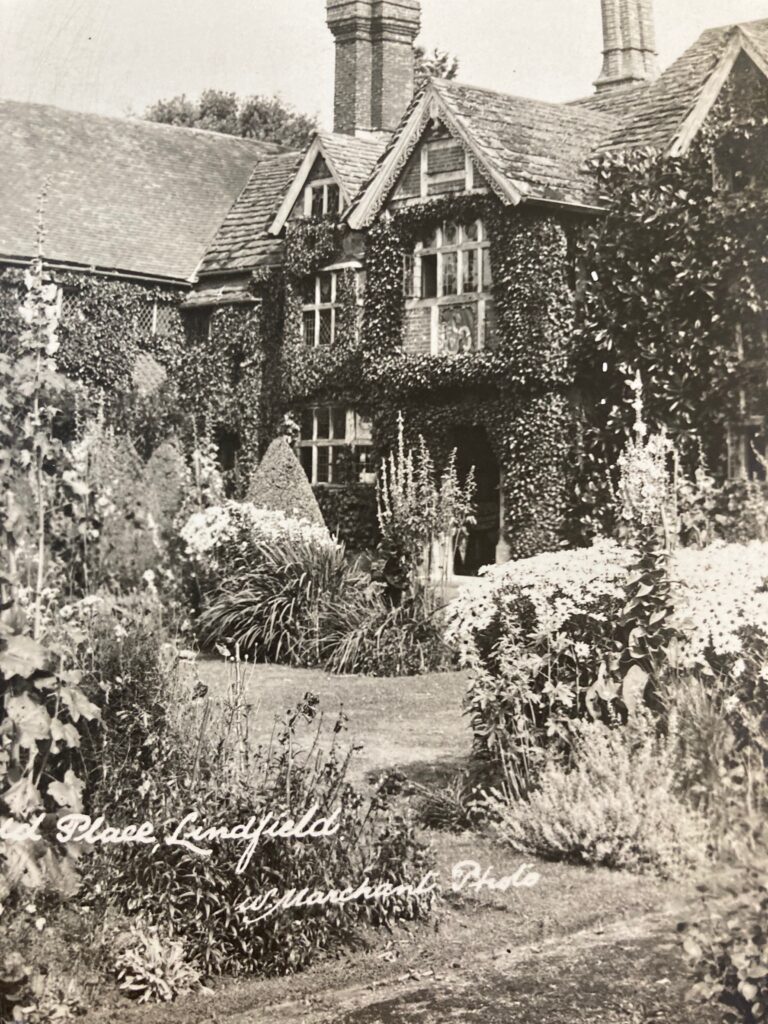
Wolseley found much to see in the garden, praising Kempe as a fine gardener and delighting in the rows of brilliant-coloured flowers leading to the sundial, and across the lawns a garden-house, two storeys high and filled with oak chests containing all kinds of fancy dress. In a letter of 1895 to her husband, she called Old Place ‘the Kempe earthly Paradise’. A collection of photographs and postcards of the house and garden and once owned by Kempe were passed to her by a mutual friend, Mrs Odell, and are now in the Frances Wolseley archive at Hove Library. Several of these photographs are labelled ‘W. Marchant’, a professional photographer and printer of postcards who had set up his business at Luxford Road, only a few minutes away from Old Place, in around 1920. The sepia and black and white prints show flower borders in a cottage garden style, with hollyhocks and delphiniums, the long grass walk that appears in the watercolour by Arthur Rowe, and a much smaller sundial, between clipped hedges. In a view which seems to have been taken from the lime tree avenue, the planting in formal borders is quite thin, but other areas of the garden are in a traditional blowsy cottage garden style. Gertrude Jekyll was a friend of both Kempe and Frances Wolseley and she may have influenced the planting.

After Kempe’s death from pneumonia in 1907 Old Place passed to his cousin, who continued to design stained glass, until in 1925 the property was sold. The house is now divided into private ownership, and the wilderness has been built on, but the Pelican Dial, now a registered listed building, remains.
Article by Sally Ingram
With appreciation to Richard Bryant and the Lindfield Historical Society for sharing their archive material about Old Place.
References
Loyal Johnson, ‘Sun-Dials, their construction and present day use’. 1928. © Archives of the RHS Library. Ref. LRJ/2/3/RHS Lindley Library.
Philip Pattenden, ‘A Pelican in Sussex’, History Today, Vol. 32. Issue 9. September 1982.
Alice Morse Earle. Sun Dials and Roses of Yesterday (1902). Macmillan, New York / London. https://publicdomainreview.org/collection/sun-dials-and-roses-of-yesterday-1902
Frances Wolseley, Sussex Typography, Vol. 43. Part 3, pp.94-104. Frances Wolseley Collection, Hove Library.
Beryl Netherclift, ‘Frances, Viscountess Wolseley’. Sussex County Magazine, Vol. 27. July 1953. No. 3, pp.342-346.
C.J. Cornish, ‘Art Within and Without’, Country Life, 20 July 1901, pp. 72-77.
‘Old Place’, Country Life, 6 October, 1900, pp. 432-440.
Ernest Rowe’s watercolours of Old Place can be seen here.
A gallery of Lindfield photographs by William Marchant c1920 can be seen here.
Earlier research by SGT: https://www.parksandgardens.org/places/old-place