
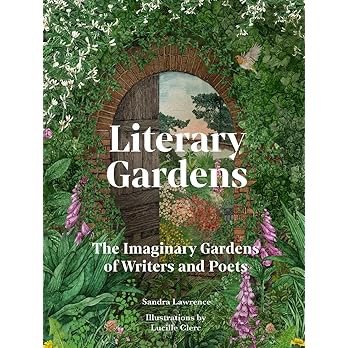
Literary Gardens: The Imaginary Gardens of Writers and Poets
Sandra Lawrence. Illustrated by Lucille Clerc.
Frances Lincoln, September 2025.
Many of the fictional gardens captured in a new anthology, Literary Gardens, will be familiar friends to readers. There’s the fantasy landscape of Alice’s Adventures in Wonderland, the tempting vegetable plot from The Tale of Peter Rabbit, and Jay Gatsby’s lavishly decadent ‘blue’ garden. But the less well-known also feature, including The Pillow Book by Sei Shōnagon, and the unexpected literary landscapes: Mort by Terry Pratchett and Raymond Chandler’s The Big Sleep.
For the editor, making a selection of personal favourites requires stamina: endless questions to oneself of should it stay or should it go? Lawrence makes sure this dilemma is out of the way in the introduction, explaining her choice excluded non-fiction, no plays so Shakespeare is out – although Wilde makes an appearance, and no poetry – but she allows the epic Ramayama. There’s even a list of writers she would have included, but regretfully had to sacrifice: John le Carre, J G Ballard, Henry James and more. As she suggests, gardens in literature can be a sanctuary and place of self-discovery (unsurprisingly, The Secret Garden begins the selection), gardens of mystery or threat, and landscapes that express the pains of growing up, of something lost and later regretted. Rather than a chronological list her selection is framed by these themes of imagination, strange worlds, fairy tales. There are gardens of delight such as von Arnim’s Elizabeth and her German Garden but then countered by Virginia Woolf’s Kew Gardens, full of restlessness and anxiety.
The anthology could have easily become a nostalgic journey through Lawrence’s personal bookshelf, but each short chapter looks closely into the author’s life and the context that shaped the writing. There’s some thoughtful research here from a writer whose most recent book was Miss Willmott’s Ghost – a much-praised biography of the often-overlooked Victorian horticulturalist, Ellen Willmott.
In a discussion of The Secret Garden, for example, we discover the significance of a robin within the troubled life of Frances Burnett, as well as a possible source for the garden, at her home at Great Maythem in Kent, which she restored after the death of her son and failure of her first marriage. Lewis Carroll’s wonderland gardens are so memorable it could become tiresome to read even more analysis, but Lawrence’s research takes a sideways glance at how the Victorians were fascinated by drugs – reminding us that the caterpillar was seen smoking a hookah – and possibly Carroll had read about the hallucinogenic effects of certain fungi in the Bodleian library just before writing Alice in Wonderland.
Inside the gardens of imagination plants can be deceptive, nasty and foreboding. Think of the ‘blood red’ fifty-foot hydrangeas in the deserted gardens of Manderley, the location of Rebecca where the new wife feels overpowered by the ghost of the first Mrs de Winter. These ‘monster shrubs’ become a reflection of a past that refuses to disappear. In Raymond Chandler’s The Big Sleep the greenhouse in the opening chapter is full of orchids, but although appearing beautiful they give off a ‘rotten perfume’, a mirror for the damp and decaying atmosphere of Chandler’s Los Angeles where the novel is set.
The evocative illustrations by Lucille Clerc recreate these surreal literary gardens (although there might be readers who imagine Manderley through the lens of Hitchcock’s darkly gothic portrayal, and Mr McGregor’s vegetable garden drawn by Beatrix Potter), but this bookis a perfect guide to exploring memorable gardens that only exist between the pages.
Reviewed by Sally Ingram