
This summer, visiting Borde Hill for the first time, I was delighted to find a magnificent garden. With many different areas, all beautifully planted it was a gardener’s paradise. Wearing my rosarian hat the rose garden was of particular interest.
The designer was Robin Williams, whose brief was to create an attractive ‘ old fashioned’ rose garden and extend the year-round interest at Borde Hill . The five hundred roses are planted in a colour wheel around a central point with some companion planting.

Borde Hill Garden – a view of the roses
Near the Victorian glasshouses there are two beds of my personal ‘gold standard’ cultivars, and some species types in the wilder parts of the garden.
On the afternoon of my visit six roses were particularly impressive, considering health, form and flowers. All of these are garden worthy as I know from personal experience. Now is the perfect time for browsing rose catalogues, hard copy or online, to make your bare root selections.
Interestingly all but one of these were bred many years ago, showing that as Graham Stuart Thomas said:
… in the Old Roses we find stalwart, thrifty shrubs, able to fend for themselves and bearing good foliage, their flowers are borne in the utmost profusion at midsummer in colours from white through pink to violet, fragrant to an unbelievable degree and showing a perfection of form evolved by skilled florists of the past, they thrive on a variety of soils and need little pruning.
He is talking about the roses of the nineteenth century, such as:
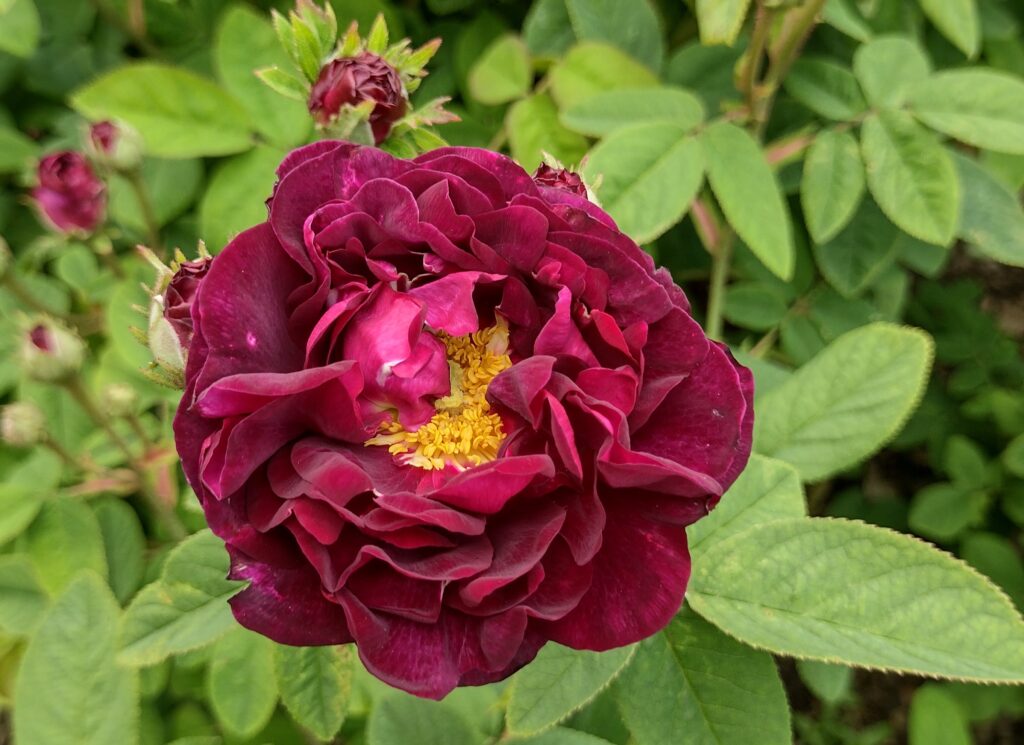
Rosa ‘Tuscany Superb’ Paul UK 1848
A glorious Gallica rose, with sumptuous blooms, strongly perfumed, healthy and the golden stamens attractive to pollinators.
Graham Stuart Thomas notes that, ‘’Gallicas – most ancient, most famous and the best garden plants ………. most important character is the flowers are held aloft and well disposed’.
An impressive rose, placed in the Gallica class, bred in the twentieth century is:
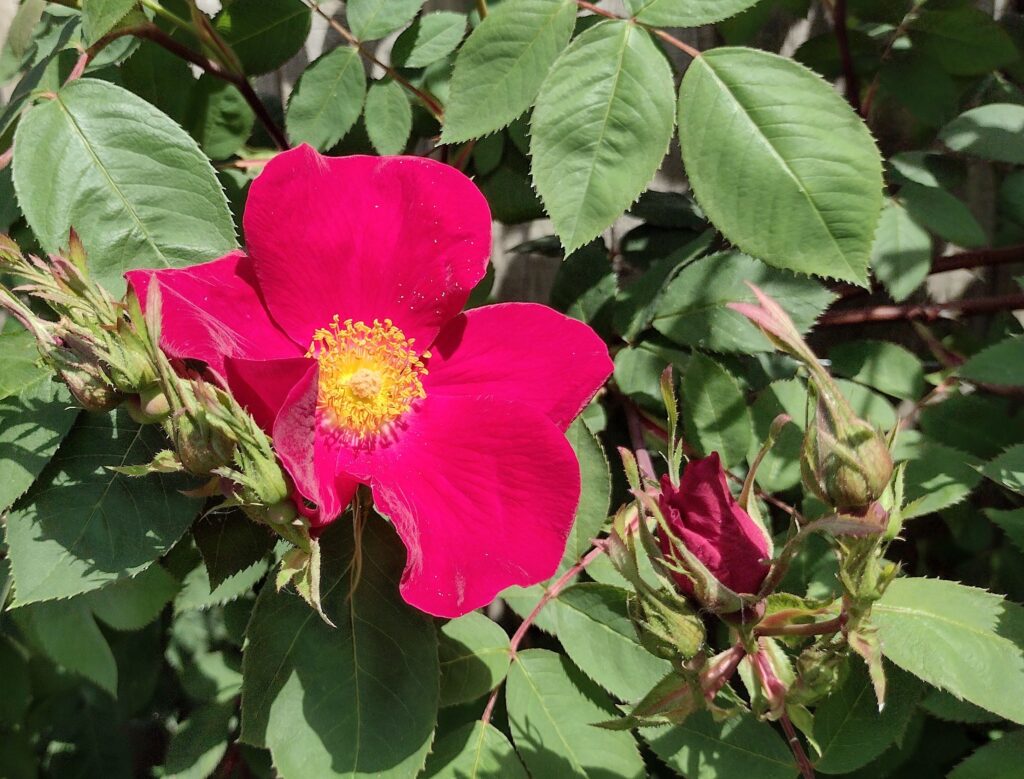
Rosa ‘Scharlachglut ( Scarlet Fire)’ Kordes Germany 1952
The large single red flowers have pronounced golden stamens and these glow in the summer sunshine. No need to deadhead as huge urn-shaped hips add to the season of interest. Responds well to training as a climber or spectacular as a free-standing shrub.
Of a different style is:

Rosa ‘Louise Odier’ Margottin France 1851
A member of the Bourbon group, which was a favourite of Vita Sackville–West, who wrote: ‘Bourbon roses are some of the mostdesirable. They inherited their fantastic scent from their damask parentage……’.
‘Louise’ is repeat flowering, vigorous and superbly scented.
Rambler roses can look spectacular growing into trees, along pergolas, or even freestanding in meadows. The one that caught my eye at Borde Hill was:
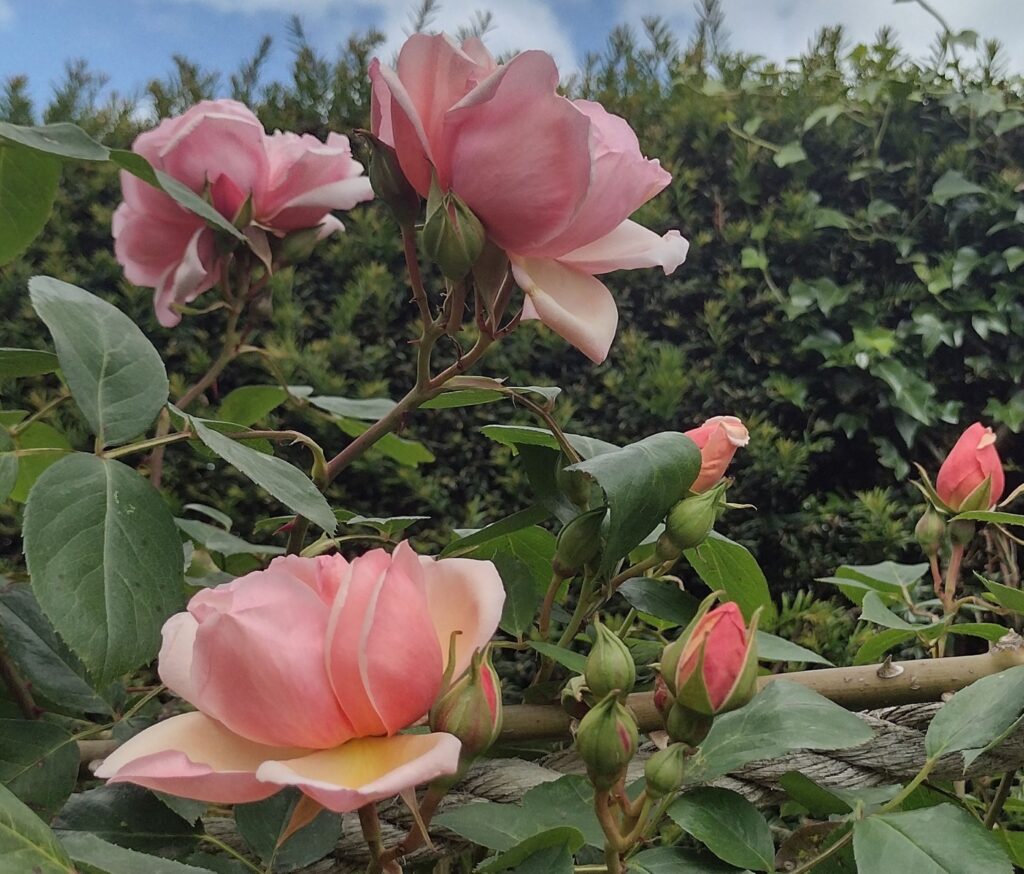
Rosa ‘Albertine’ Barbier France 1921
Her healthy glossy foliage, which often has a coppery red tinge, sits well against the beautiful flowers. These start as shapely buds which open to full blooms of lobster pink with a golden base, fading to pale pink as they age. Highly scented and very floriferous she was the star of the pergola that day at Borde Hill.
Gertrude Jekyll loved using roses in her designs. Her thoughts on pergolas always make me smile, one was obviously expected to have a large plot!
A Rose pergola should be so placed that it is well seen from the sides…. One that crosses some open grassy space, or that forms a middle line in the design of one complete garden scheme …
A so-called ‘modern‘ rose which deserves a place in any garden is:

Rosa ‘Sally Holmes’ Holmes UK 1967
A magnificent Floribunda, generous in bloom, and excellent as a cut flower. I especially love the comparison of her apricot buds with the creamy white flowers. Each stem can carry a truss of up to twenty blooms.
Finally, a ‘gold standard’ rose, but what does that mean? When judging roses for garden worthiness, I am marking them out of 100 points. Gold standard means they received over 75 points – so you can purchase them safe in the knowledge they will perform well.
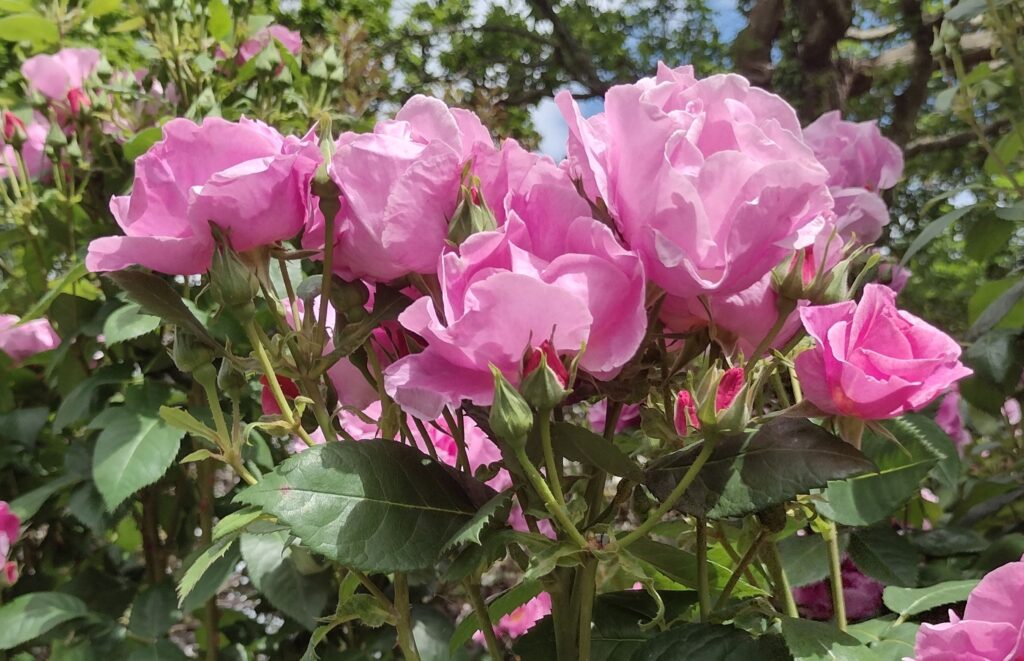
Rosa ‘Lucky!’ Fryer UK 2009
A continuous flowering Floribunda who is robust, healthy and attractive. The fragrant flowers are produced in large clusters on upright stems and do well as cut flowers. An excellent choice for the back of a border.
I leave you with a quote from Reverend Canon Hole: ‘He who would have beautiful roses in his garden must have beautiful roses in his heart’.
NB. The date in italics is when the rose was introduced with the name and country of the breeder.
Article and photos by Gillian Taylor
Gillian Taylor is an International Rose Trials judge, where plants are assessed for garden worthiness, and an active member of the Rose Society UK.