
The UK has been shown to be one of the world’s most nature-depleted countries in the world. The figures speak for themselves. Bird populations continue to decline with 48% of species decreasing between 2015 and 2020 and woodland birds faring the worst. Although a carpet of wildflowers still covers the chalk downlands of southern England, including rare orchids, cowslips, rampion, vetch and milkworts, only 2% of natural wild meadows remain that once existed in the 1930s.
A nature notebook, written in the early 1900s, offers a glimpse of the natural world on the Sussex downland, before these changes in biodiversity began to affect the landscape. This small hardback notebook, filled with diary entries and drawings and which recently came to light at the RHS Wisley Library, was kept by Cornelia Cracknell, the co-principal of a gardening school for women at Clapham, a village on the Downs near Worthing. Together with her partner, Florence Collins, she ran the School of Gardening and Nature Study from 1912 until 1937 and continued living in the village until her death in 1969.
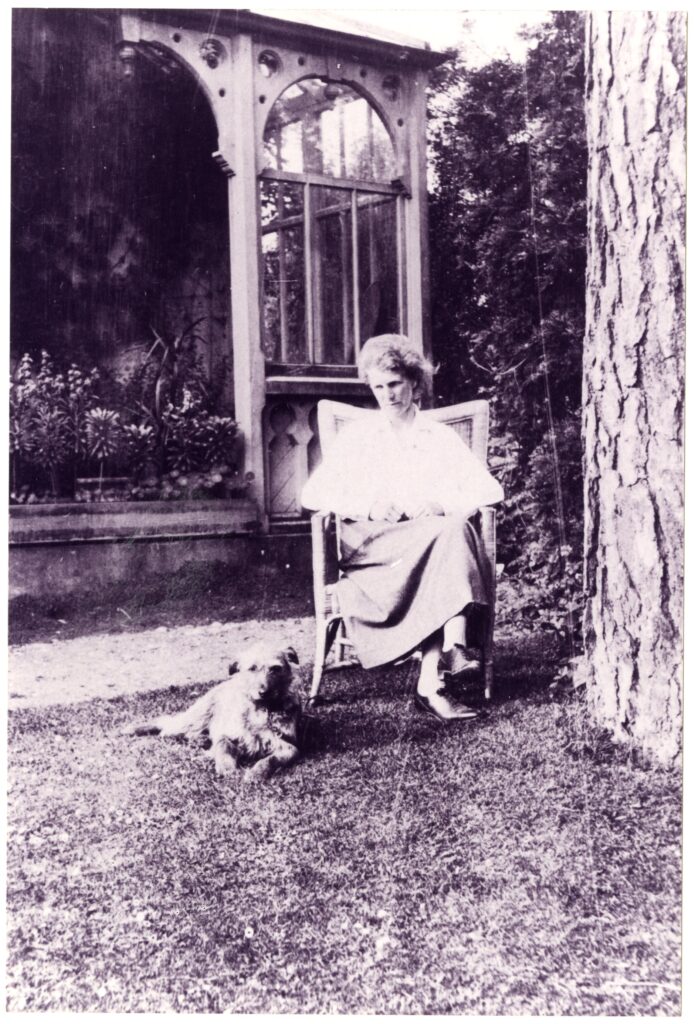
Cornelia, who also called herself Nancy, was born in 1880 at Valley Farm in Wickham Market, Suffolk, the youngest of seven children with five sisters and a brother, then aged eleven. Her father, John, farmed 380 acres of land and lived into his seventies, but her mother, Emma, died in 1884 at the age of 47, of a strangulated hernia, perhaps caused by another pregnancy. Cornelia’s brother and her sisters stayed close to the area around Wickham Market, marrying, bringing up their families and working on local farms. While census returns and registers of births and deaths reveal something of this history, we can only speculate as to why Cornelia imagined a very different life for herself at the turn of a new century and chose to leave her birthplace. In 1901 she had become a teacher in Norwich, and by 1911 she had taken the ambitious step of setting up a gardening school with Florence Collins, also a teacher, at Wimborne in Dorset.
In 1912 the two women moved again, to Clapham, then a small, rural village with a school and a few cottages clustered around the main road, leading to a farm and the church. The Rectory was in the centre of the village, originally a cottage belonging to the church, which had been put up for sale in 1911 and provided enough land to house poultry and cattle and a house large enough for residential student gardeners. Florence Collins became the teacher of nature study and Cornelia Cracknell taught gardening.
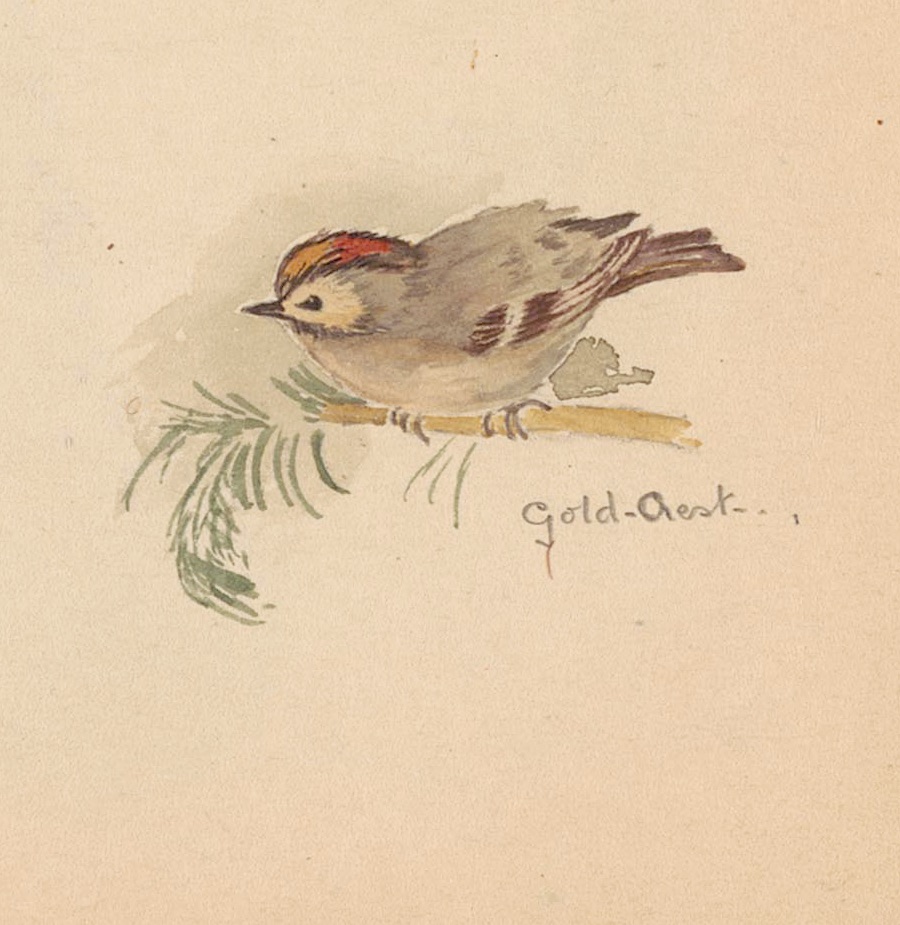
The nature notebook, inscribed ‘Miss Nancy Cracknell, School of Gardening, Clapham’, begins a year after Cornelia moved into the rectory and contains her handwritten notes and delicate watercolours of plants and wildlife observed in the rectory garden and on the South Downs. From the spring of 1913 until November 1917, she documents the natural world around her: all the wildflowers found on a particular walk, the plants that grow on chalk, a list of birds seen in early spring and the names of birds that sing as they fly. She keeps a monthly account of the weather, notes the days when she heard the first cuckoo calling at Clapham, or saw the earliest swallows, ‘the Nightingale on the Common, the Chiff-Chaff and the Willow Wren’. But this is not a sentimental or whimsical journey through nature. Her writing is underpinned by an acute knowledge of botany and of local traditions, such as the practice of shepherds catching wheatears in traps for selling to dealers in Brighton and Eastbourne. In the nineteenth century these birds were considered delicacies and shepherds in Sussex supplemented their income by capturing as many as a hundred in a day. She notes that by the 1900s such practice caused the birds to become rare – the only reference in the notebook to a decline in wildlife caused by human activities.
The diary continues throughout the First World War, when on the Sussex coastline the sounds of guns could apparently be heard from across the Channel in France, but the focus of her notebook is contained within the world close by: the habits of the leaf-cutting bee, which cut three leaves from a rose in the Clapham garden in three minutes, the coloured plumage of the white throat and the goldcrest seen in the pine trees, or the different shaped leaves of the common oak. The greatest hardship that she records is the weather of 1916-17, known as the severe winter of the Great War, when she writes in February that a sharp spell of frost has killed hundreds of birds, unable to find food in the frozen ground.
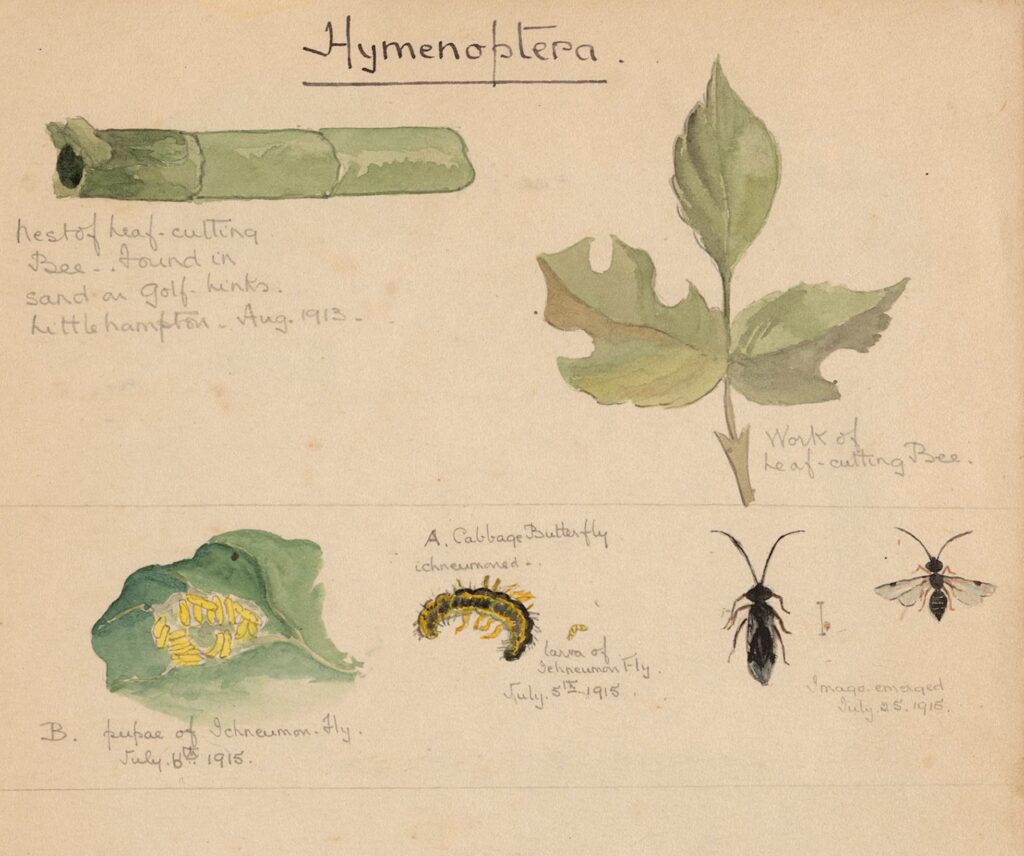
The garden notebook gives a personal insight into Cornelia Cracknell’s sphere of interests, her day-to-day observations made more remarkable when viewed against the wealth of current writing about the natural world.
If Cornelia’s notebook was shared with the students remains unknown, but such sensitivity to her surroundings was perhaps a foundation for the future. When her constant friend, Miss Collins, in later life lost her sight it is said Cornelia became her eyes, describing everything to her in the minutest detail.
________________________________________________________________________
Cornelia Cracknell’s Garden Notebook has now been presented by the RHS to the West Sussex Record Office (WSRO), returning the book to its home in Sussex. Ref. AM 1712/1.
All images are by kind permission of WSRO and should not be reproduced. _________________________________________________________________________
A full account of the Gardening School for Women at Clapham features in the latest edition of the SGT Journal, which has a wide range of scholarly articles with new research focussing on Sussex. All our members will be receiving a copy through the post in November.