
It was almost the summer solstice when I joined Horsham Arts Society trip to Vita Sackville-West’s beautiful gardens at Sissinghurst in Kent. The early morning had started alarmingly with thunder, lightning and heavy rain, although thankfully this did not last too long and by the time we left Horsham it was dry. The journey however, suffered from flooding delays, and a little rain, but the sun was shining and it was quite humid when we eventually arrived at this stunning National Trust garden.
The Sissinghurst estate has had a chequered career, from Saxon pig farm to moated manor house, to Elizabethan courtyard house, then from an eighteenth-century prison to a workhouse. Eventually, in the nineteenth century, it was reclaimed back into a family manor house to be bought in 1930 by Vita Sackville-West and her husband, Harold Nicolson. They worked together, to create around the buildings gardens of informal planting held within formal designs. He was the designer, she the plants woman. Sissinghurst was inherited by their son Nigel Nicholson, who transferred the estate to the National Trust in 1969 although continued to live there. His son, Adam Nicholson still lives there with his wife, the horticulturist Sarah Raven and their two children.

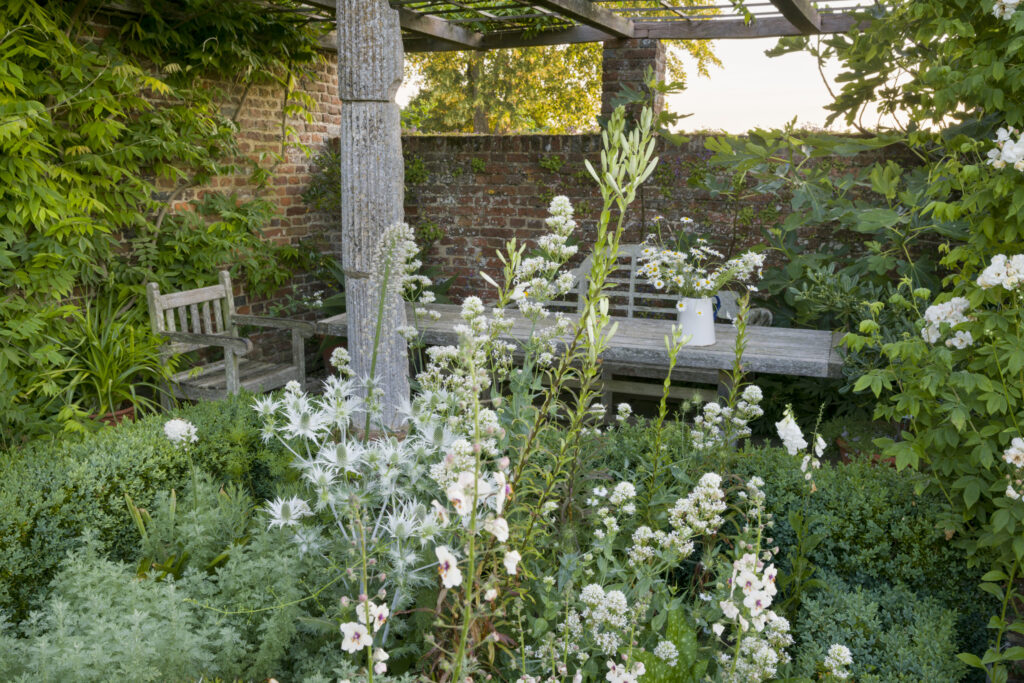
First on my list to see was the White Garden. Being mid-June, this was a good time to see it, although I was concerned the heavy rain might have damaged the blooms. I need not have worried, it was magnificent. The borders were overflowing with wonderful white flowers: foxgloves, ox-eye daisies, roses, paeonies, lilies, love-in-a-mist, hardy geranium, and many more amongst a variety of grey and silver leaved plants. The formal bit was brick paving and paths, narrowly edged by slim box hedging, and the central focus of a rose arbour with planted pots. It is a garden that certainly does not disappoint.
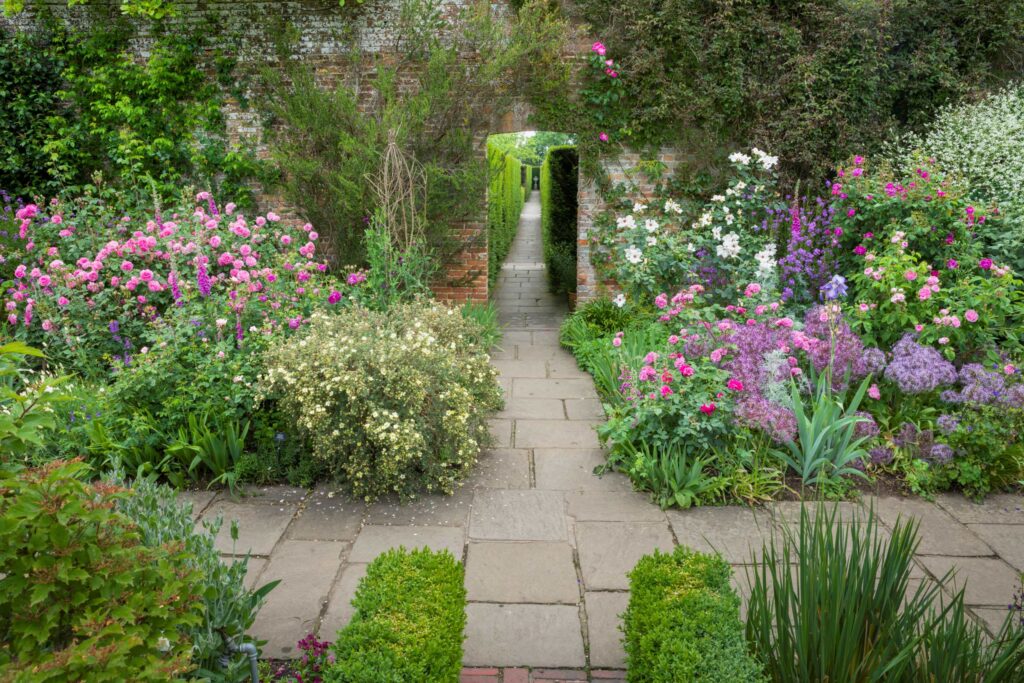
Next was the cottage garden and rose garden. These were both full of colour, pinks of various shades, purples and yellows, plus a lovely deep blue from salvias. There was little room for weeds amongst the billowing flowers. The old brick walls were well covered with climbing roses. I was struck by the work this must need to maintain the wonderful over abundant display. There is in fact a team of dedicated gardeners and volunteers, two of which I passed putting in dahlias for a later display.
From here I went to the old tower in the centre of the gardens and climbed the 78 steps up to the top to get a bird’s eye view of the gardens and their setting in the rural Kent countryside. There are a number of old Tudor buildings; barns, cottages and oast houses which were originally part of the farm and manor. These are now converted to a restaurant, café, plant shop, gift shop, exhibition space and National Trust rentals. Vita and Harold had spread themselves around the estate using South Cottage as bedrooms, a long barn as a library and half way up the tower was Vita’s writing room, recently restored.
The last garden I was able to visit was Delos which was covered in stone from all over the garden and apparently originally reminded Vita and Harold of the Greek Island of Delos, hence its name. It went through many changes but is now a Mediterranean garden, with alpines and shrubs and the odd pillar or two. There are Magnolias and Cyprus trees and far-reaching views to the Kent Weald.
A whole day at Sissinghurst would not go amiss. There is a long walk of three miles around the fields and a shorter walk of one mile. These walks take you to the lakes, a bird hide, orchard and vegetable garden which I was sorry to have missed. I will just have to come back.
Report by Maggie Weir-Wilson