

Reading in GT News that Michael Tooley, the Jekyll authority, had died in June last year, I remembered how generous he had been whilst I was undertaking research into Gertrude Jekyll for SGT. Tracking him down in retirement in Fife involved much detective work (often the best bit of garden history research) but once I had found his contact details I was delighted to discover that he was extremely happy to share his knowledge. He felt his Jekyll research was in the past but seemed to have excellent recall of much of it and offered to let me rummage through his ‘disorganised’ files in his garage. An offer I bitterly regret not taking up when en route to the Outer Hebrides in 2021.
It was on that trip north that we broke our journey in Northumberland in order to visit the little garden Gertrude Jekyll designed for her friend and colleague, Edward Hudson, the founder of Country Life, on Holy Island. Hudson had purchased Lindisfarne Castle, a sixteenth century defensive fort built on an unassailable basalt outcrop on the remote island, in 1902 and he planned to develop the castle as a dramatic summer holiday retreat, using the combined expertise of Lutyens and Jekyll. Surprisingly, given her famous reluctance to travel, Jekyll visited in 1906 with Lutyens and, appropriately, his pet raven. Hudson had hoped to create an elaborate water garden in the grassy valley below the castle and to turn the old walled kitchen garden into a tennis court, but the escalating costs of restoration forced him to restrict horticulture to the walled enclosure. Lutyens used geometric false perspective in his design to stretch the seventy-five feet square garden into an irregular trapezoid, altering two of the walls and the cruciform grid to improve the bird’s eye view and make the relatively small space appear larger when viewed from the castle windows. Jekyll provided two plans in 1911: one for the first year, consisting of vegetables and annuals, and a second plan showing a dominant mix of colourful July and August flowering annuals, perennials and small shrubs and only one border devoted to edible produce. These drawings are held at Reef Point, the resource much used by SGT in research for Gertrude Jekyll in Sussex.
Accounts of the refurbishment of the castle and subsequent visits from Hudson’s friends read like a Boy’s Own adventure: Lutyens was in his element, scrambling around the semi-derelict fort and planning the transformation from garrison to luxurious holiday residence, but all materials for the conversion had to be transported laboriously from the mainland and access was entirely tide-dependant. Hudson’s house parties included such diverse companions as Lytton Strachey, J.M. Barrie, Ben Nicholson, the Prince and Princess of Wales and the then Prime Minister, Herbert Asquith and they were entertained with fishing trips, theatrical entertainments and recitals by the flamboyant cellist, Guilhermina Suggia (who was engaged to Hudson for a time). Not all of the guests appreciated the elemental site; the castle was always damp and frequently buffeted by wild storms, access to the island was difficult and once there the entrance was a scramble up precipitous and unprotected stone steps. No doubt much fun was had but Hudson sold his improbable holiday castle in 1920. Two owners followed before the island was acquired by the National Trust in 1944 and both the castle and the walled garden were restored in 2002-2006.
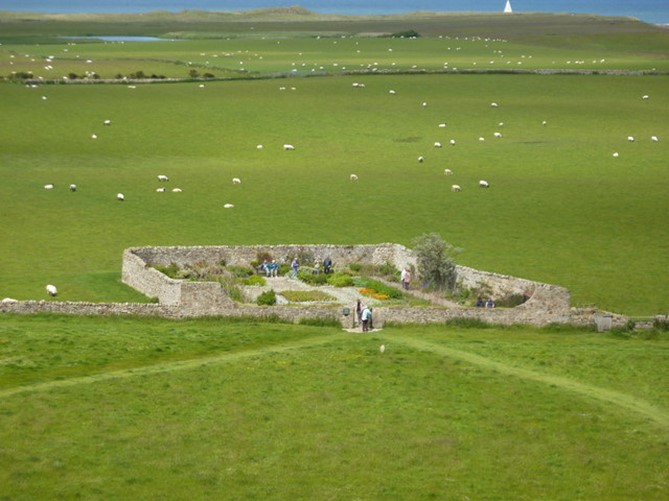
Unflappable though she was, Gertrude Jekyll must have found the windy, salt-laden site an unusual challenge, but thick walls provided some shelter and she filled the garden with many of her signature plants, set effectively against the grey stone. The northern border was packed with perennials (hollyhocks, gladioli, Japanese anemones and sunflowers), the western border with hybrid tea and Bourbon roses and the eastern border with fruit and vegetables. The central beds were planted with a mix of cornflowers, campanulas, centaureas, delphiniums, sweet peas and grey-foliaged plants such as Stachys byzantine and Sedum telephium. The walled garden may not have been her only contribution, though, as it is rumoured that she also fired seeds at the rock face below the castle from a shotgun and lowered a seven-year-old island boy down in a basket to reach the more inaccessible ledges. If true, Lutyens must have been delighted.
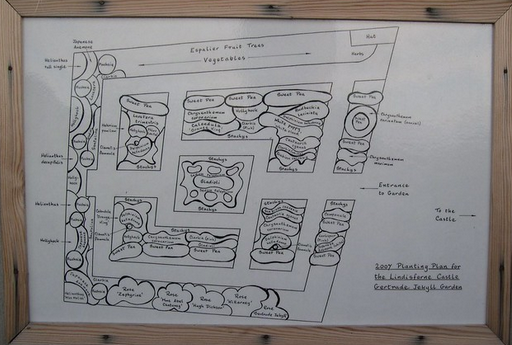
Recreated plan for the National Trust restoration
Sadly, Jekyll’s choices proved optimistic in bleak Northumberland and many of her plants failed to thrive. A hundred years later the National Trust amended her plan to extend the flowering season whilst keeping to her original layout and the tiny space is once again unexpected and captivating. Surely, apart from a single window sill in for a young factory employee in Rochdale in 1870, this was Gertrude Jekyll’s most unusual commission? In a neat coincidence, both of these gardens are discussed in an article by Michael Tooley in ‘Gardens Designed by Gertrude Jekyll in Northern England’ (Garden History, Vol. 8, No. 3 Winter, 1980).
Article by Susi Batty
All photos © Susi Batty